

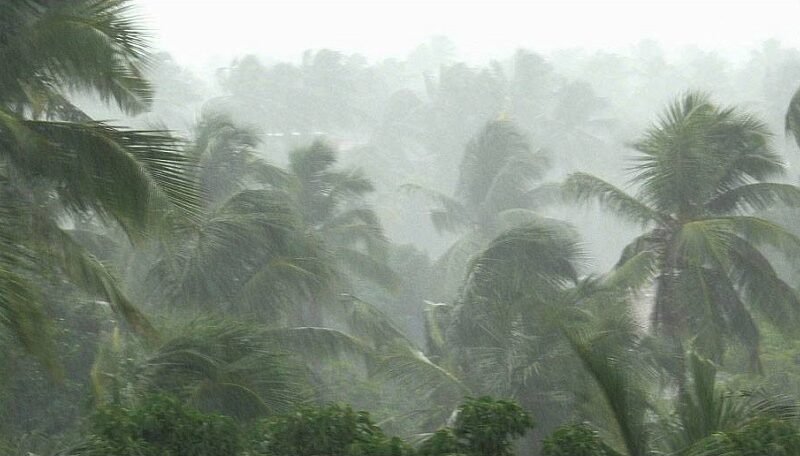
Mumbai (Gurpreet Singh): The arrival of the Southwest Monsoon in South Konkan has triggered heavy rainfall warnings for the districts of Ratnagiri and Sindhudurg until June 9. While the seasonal system has made landfall in Maharashtra, meteorologists predict a temporary reduction in rain intensity across the state over the coming week. Simultaneously, the India Meteorological Department has logged the arrival of the monsoon in the northeastern border states of Mizoram and Manipur. Weather models indicate that the system will expand further within the next two days, enveloping extra territories in Karnataka, Maharashtra, Telangana, Andhra Pradesh, and the remaining parts of the northeastern zone.
Even as heavy downpours saturate multiple districts across Keralam, Karnataka, Goa, and Tamil Nadu, contrasting climatic conditions are emerging elsewhere. For instance, the capital of Tamil Nadu, Chennai, surpassed the 40°C threshold for a fifth consecutive day. At the same time, northern plains and adjoining regions, including Punjab, Haryana, Chandigarh, Delhi, Uttar Pradesh, and eastern Rajasthan, are facing a fresh spell of intense summer heat, leading authorities to issue official heatwave advisories.
Prior to the formal arrival of the seasonal front, pre-monsoon precipitation has impacted nearly the entire country, leaving Gujarat as the sole exception. High-velocity winds reaching speeds of 50 km/h knocked down trees and disrupted daily life in Madhya Pradesh on Saturday, while Bikaner in Rajasthan witnessed a sudden hailstorm. Heavy showers and lightning strikes were also reported across parts of Uttar Pradesh, Bihar, and Jharkhand.
Recovering from an initial three-day delay, the monsoon has accelerated significantly, crossing into seven states within a four-day window. The atmospheric front moved into Andhra Pradesh, Maharashtra, Mizoram, and Manipur on Saturday, hot on the heels of its Friday arrival in Karnataka, Goa, and Tamil Nadu. Forecasters anticipate the system will engulf all northeastern states and segments of West Bengal within three days, before advancing toward Bihar, Jharkhand, and Odisha over the next ten days. However, independent weather experts suggest that progress through central India could slow down because of a lack of supportive low-pressure systems in the Bay of Bengal.
Beyond regional updates, global climate monitors from Europe have confirmed that the warming phase of the Pacific Ocean has officially crossed into an El Niño state. Ocean surface temperatures have exceeded baseline levels, and researchers estimate a potential spike of up to 3°C above average values by December. If these projections hold true, this specific cycle could eclipse the severe weather disruptions recorded during the historic 1997-1998 and 2015-2016 phases, with extreme simulations pointing toward a possible 4°C rise.
The short-term forecast for June 8 details intense precipitation across the southern peninsula, alongside convective storms in Odisha, West Bengal, Bihar, and Jharkhand. Gusty winds and dust storms will likely affect Rajasthan, Delhi, Punjab, and Haryana. By June 9, wet conditions will linger over coastal and southern regions, whereas severe heatwave warnings remain active for Andhra Pradesh and Odisha, with the latter expected to experience unusually warm night-time temperatures.
