

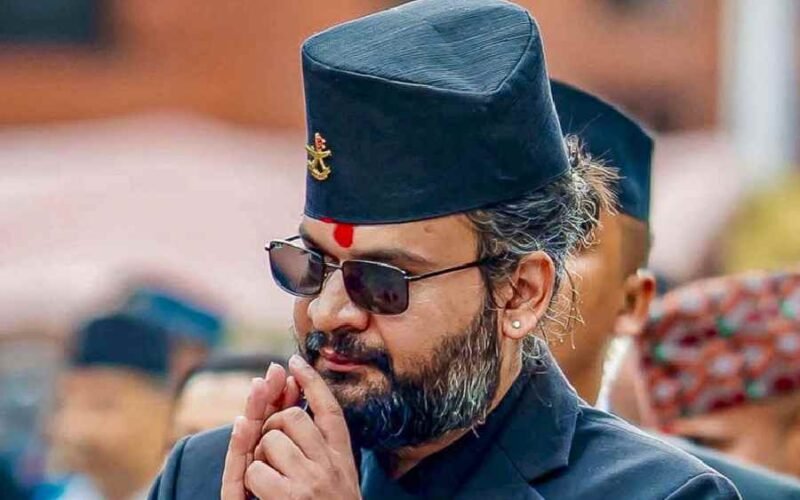
Kathmnandu (Rajeev Sharma): Nepal’s newly elected Prime Minister, Balendra “Balen” Shah, has sparked a major political controversy following his first address to the country’s Parliament regarding long-standing boundary disputes with India. Speaking on Sunday during a parliamentary session in Kathmandu, the 36-year-old leader claimed that both India and Nepal have encroached upon each other’s territories, drawing sharp criticism from opposition benches at home and raising diplomatic eyebrows in New Delhi.
Addressing the House of Representatives for the first time since his party’s landslide victory in March, Shah stated that the issue of territorial lines should not be used as a political tool but evaluated strictly through historical data, expert consultation, and technical mapping. “You will be surprised to know about a fact, which I have learnt recently only after becoming the Prime Minister,” Shah told the parliament. “India has not only encroached Nepalese territories, but Nepal has also encroached India’s territories in many places. Now both countries should study the facts and sit together as friends and resolve the issue.”
The premier confirmed that the Nepal government has officially dispatched a diplomatic note to New Delhi regarding the status of contested regions—specifically Lipulekh, Kalapani, and Limpiyadhura—and has already received a formal response. According to Shah, both nations have agreed to form joint committees featuring historians, surveyors, and technical experts to settle border delineations peacefully. He also revealed that Kathmandu has held separate diplomatic talks on the tri-junction sector with China and the United Kingdom, noting that the root of the dispute dates back to the British colonial era.
The “mutual encroachment” remark has triggered immediate domestic backlash, with opposition parties like the Nepali Congress and CPN-UML accusing the young prime minister of diluting Nepal’s sovereign claims over Kalapani and Lipulekh. Observers note that while Shah has historically maintained a staunchly nationalist, “Nepal-first” posture, his latest comments represent an unexpected rhetorical shift toward a balanced, fact-based bilateral verification process, highlighting the complex geopolitical tightrope the new administration must walk.
