

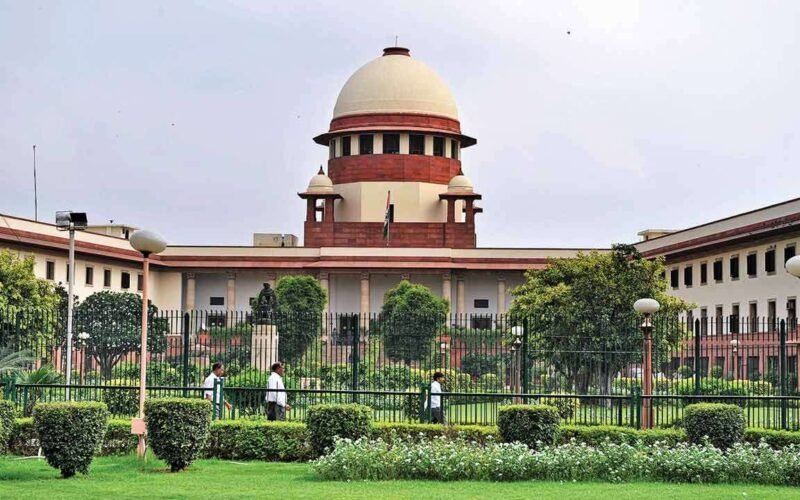
New Delhi (Gurpreet Singh): The Supreme Court of India has delivered a landmark ruling affirming that voluntary adult sex workers cannot be forcibly “rescued” or detained against their will. A Bench comprising Justice J.B. Pardiwala and Justice R. Mahadevan declared that the personal consent of an adult sex worker must be treated as the primary consideration by authorities when making decisions regarding their rehabilitation, reintegration, or temporary placement in protective shelter homes.
The apex court issued these sweeping directions while adjudicating a 22-year-old public interest litigation filed by the non-governmental organization Prajwala, which sought robust national measures to combat human trafficking and protect victims of Commercial Sexual Exploitation. Invoking its extraordinary powers under Articles 32 and 142 of the Constitution to protect essential fundamental rights, the top court ordered the immediate formulation of a nationwide “Victim Protection Plan.” This comprehensive protocol will standardize rescue operations, victim identification, prosecution guidelines, and inter-institutional coordination across all states until Parliament enacts a dedicated law on the matter.
In the judgment, the Bench rejected the paternalistic and “one-size-fits-all” approach long embedded in Section 17 of the Immoral Traffic (Prevention) Act, 1956. Justice Pardiwala noted that the historical implementation of the law flawed company by indiscriminately treating all individuals found in prostitution-related situations identical, failing to differentiate between coerced victims of human trafficking and individuals voluntarily participating in sex work. The court observed that because an individual’s fundamental life, personal liberty, and future security are determined by judicial orders, it remains entirely incongruous to decide their custody without any regard for their explicit personal choices and operational autonomy.
Under the newly established guidelines, when an adult is produced before a magistrate following enforcement action, the court must conduct an immediate threshold inquiry to determine if the individual is engaging in sex work voluntarily and if they actually desire long-term protective custody. While preliminary assessments from trained social workers may assist the judiciary, the victim’s own statement must be granted legal primacy. A magistrate may only deviate from the individual’s expressed wishes in exceptional, recorded circumstances where an immediate release presents a documented safety risk or where consent appears to be the structural product of intimidation, coercion, tutoring, or undue influence.
Crucially, the Supreme Court drew a sharp legal distinction regarding cases involving minors and systemic coercion. The Bench clarified that for child victims of trafficking for commercial sexual exploitation, the element of consent is legally irrelevant. Such cases will automatically attract charges under the stringent Protection of Children from Sexual Offences Act, alongside corresponding anti-trafficking provisions under Sections 143 and 144 of the Bharatiya Nyaya Sanhita and the Immoral Traffic (Prevention) Act. For adults, consent similarly becomes legally immaterial if the perpetrators utilize force, abduction, fraud, deception, or the abuse of power to facilitate exploitation. However, the court explicitly directed police forces to completely refrain from harassing, victimizing, or interfering with consenting adult sex workers during targeted raids on brothels.
