

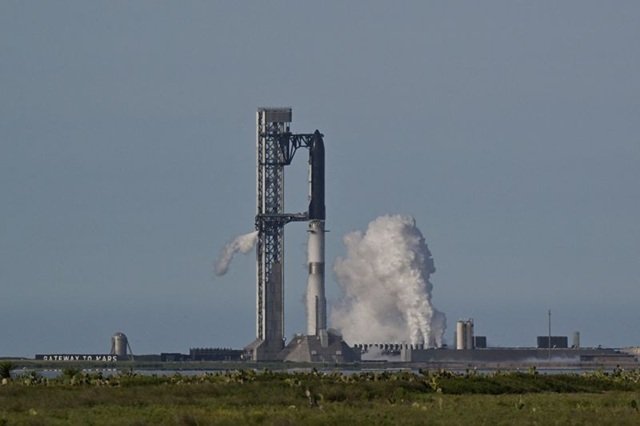
Washington (Rajeev Sharma): SpaceX’s highly anticipated launch of its newest Starship prototype was postponed at the last moment on Thursday after engineers encountered unexpected technical complications during the final countdown.
The massive rocket, standing nearly 407 feet tall at the company’s Starbase facility in South Texas, was fully prepared for liftoff and expected to embark on a suborbital journey across the globe. Excitement built as the countdown entered its final seconds, but a chain of launch system issues forced mission controllers to stop the attempt before ignition.
The delay came as SpaceX prepared to test the most advanced version of Starship yet — a vehicle considered critical to the company’s long-term plans for lunar travel, Mars exploration, and satellite deployment.
SpaceX chief Elon Musk later confirmed that the launch halt was triggered by a malfunction involving the hydraulic mechanism designed to retract one of the launch tower’s stabilising arms. Without the arm clearing properly, the system could not safely release the rocket.
Engineers immediately began assessing the issue, and Musk indicated another attempt could take place as soon as Friday if repairs are completed on schedule.
The planned mission was designed to send Starship on an hour-long flight path over the Earth before ending in a controlled splashdown in the Indian Ocean. During the flight, the spacecraft was expected to deploy 20 simulated Starlink satellites as part of testing its future payload delivery capabilities.
This would have marked the rocket’s 12th experimental flight and its first since late last year, offering key data for performance upgrades and design refinements.
The timing of the aborted launch drew extra attention as it came shortly after Musk revealed plans to publicly list SpaceX, a move that could reshape the global commercial space industry.
NASA is closely monitoring Starship’s progress, as the vehicle is central to upcoming Artemis missions that aim to return astronauts to the Moon later this decade.
Though the delay was disappointing for spectators and mission teams, such interruptions are common in modern rocket development. SpaceX has repeatedly emphasized that these test flights are designed to identify flaws early, allowing engineers to improve reliability before operational missions begin.
