

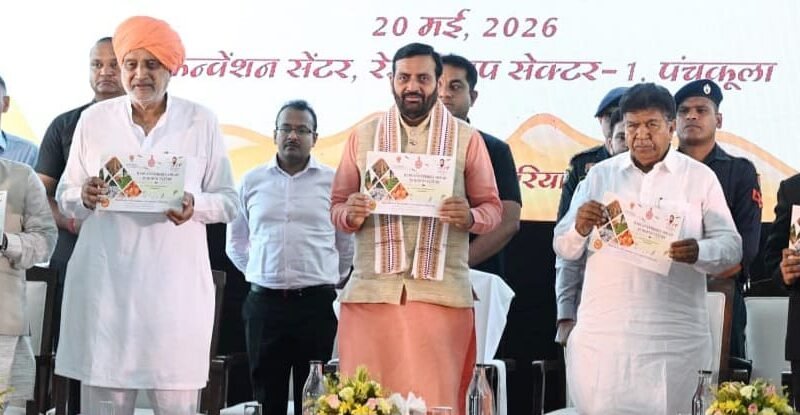
Chandigarh (Balwinder Singh): Moving progressively from the White Revolution to the Sweet Revolution, Haryana has established a comprehensive apiculture policy aimed at scaling up its honey economy. Addressing beekeepers at a state-level event organised by the Haryana Horticulture Department in Panchkula to mark World Bee Day, Chief Minister Nayab Singh Saini announced that the state aims to increase the number of active beekeepers to 7,750 and elevate total honey production to 15,500 metric tonnes by the year 2030. Highlighting the state’s pioneering achievements, the Chief Minister noted that Haryana has clinched the top position in the country for registering the highest number of beekeepers on the National Beekeeping and Honey Mission portal. Agriculture and Farmers’ Welfare Minister Shyam Singh Rana was also present at the convention.
To shield farmers from market volatility, the Haryana government has formally included beekeeping under its flagship Bhavantar Bharpai Yojana, fixing a protective base price of 120 rupees per kilogram for honey. Marking the implementation of this welfare measure, Chief Minister Saini digitally transferred incentive subsidies worth 1.02 crore rupees directly into the bank accounts of thirty progressive sweet-revolution farmers during the event. Furthermore, to safeguard rural entrepreneurs against natural calamities, the government has integrated the apiculture sector into the Chief Minister Horticulture Insurance Scheme. The state also provides extensive financial assistance, offering up to an 85% subsidy on the procurement of bee boxes, colonies, and essential maintenance equipment.
Underscoring the critical ecological and economic role of bees, Saini described them as the backbone of the agricultural economy and the environment. He urged traditional farmers cultivating mustard, sunflower, cotton, and various horticultural crops to simultaneously adopt beekeeping, as cross-pollination naturally enhances overall crop yields. Beyond honey, the Chief Minister pointed out that high-value by-products like royal jelly, bee venom, propolis, and beeswax hold massive demand in global pharmaceutical and cosmetic industries, yielding profits several times higher than honey alone. To support commercial production, the country’s first Integrated Bee Development Centre has been established with Israeli technical collaboration at Ramnagar in Kurukshetra, which handles specialized extraction, processing, and marketing training, and has already facilitated 800 tonnes of honey trade.
The state’s efforts towards agricultural diversification have yielded substantial results, with the total horticultural cultivation area expanding from 1.17 lakh acres in 2014 to 2.73 lakh acres today. Noting that Haryana currently produces about 5,000 metric tonnes of honey annually, Saini encouraged women, landless labourers, and rural youth to establish local honey brands and startups using the state’s financial and technical support structure to transform Haryana into a major honey hub. During the event, the Chief Minister honoured eleven progressive beekeepers with citation certificates and cash rewards of 11,000 rupees each, alongside releasing a departmental publication highlighting the state’s latest horticultural advancements. Agriculture Minister Shyam Singh Rana added that under the current administration, the state continues to lead national agrarian reforms, including the procurement of twenty-four crops at Minimum Support Price and setting up laboratories across ten districts to support organic farming.
