

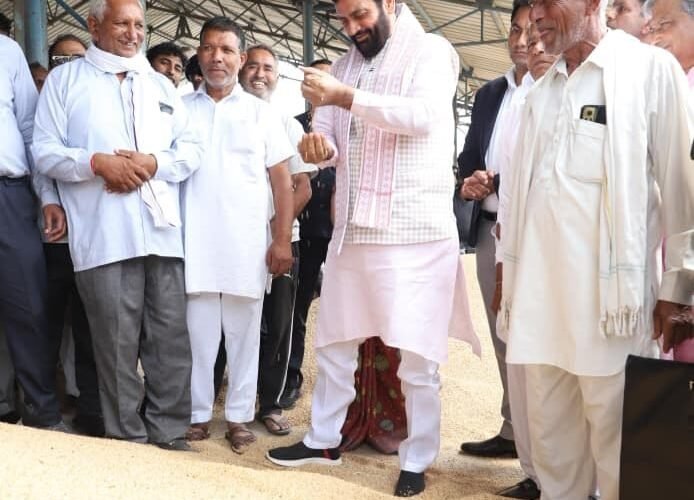
Chandigarh (Balwinder Singh): Haryana Chief Minister Nayab Singh Saini on Saturday, April 11, 2026, assured farmers that the state government is fully committed to purchasing every single grain of their produce. During a visit to the Babain Grain Market in Kurukshetra to inspect the ongoing wheat procurement process, the Chief Minister emphasized that new initiatives have been implemented to make the system more transparent, secure, and farmer-friendly. He stated that these reforms are designed to eliminate unauthorized activities and ensure that farmers receive swift, convenient services without bureaucratic hurdles.
To ensure accuracy, the government has mandated a three-tier crop verification system. This mechanism matches the crop brought to procurement centres with the data registered by the farmer, making the verification process more reliable. Chief Minister Saini interacted with several farmers at the Mandi, including Dharamchand, a farmer from Hamidpur, whom he honoured with a shawl. The farmers expressed satisfaction with the arrangements, noting that payments and crop lifting were proceeding smoothly.
Key Procurement and Monitoring Measures:
- Nodal Officers: Dedicated nodal officers have been appointed in every Mandi across the state to oversee daily operations.
- District Oversight: Deputy Commissioners have been made the in-charges of procurement arrangements at the district level, with senior officials tasked with regular monitoring.
- Legislative Monitoring: Ministers and MLAs have been directed to frequently visit Mandis to resolve any on-ground issues faced by farmers.
- Accountability: The Chief Minister reiterated that the government is operating with full accountability to ensure that farmers do not face any inconvenience during the peak season.
The Chief Minister was accompanied by several senior officials, including Deputy Commissioner Vishram Kumar Meena and Superintendent of Police Chandra Mohan. He concluded his visit by reaffirming that the Haryana government stands firmly with the farming community and will continue to prioritize their welfare through systematic improvements in agricultural marketing infrastructure.
