

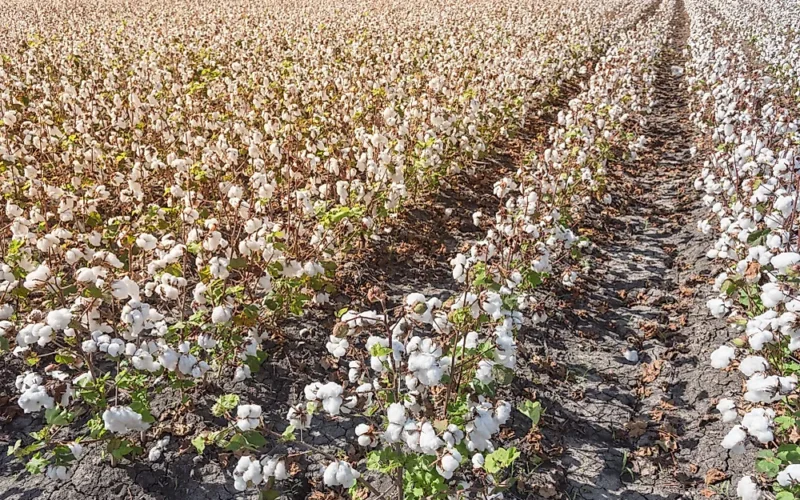
New Delhi (Gurpreet Singh)— In a significant move to bolster India’s agricultural sector, the Cabinet Committee on Economic Affairs, chaired by Prime Minister Narendra Modi, on Wednesday approved a minimum support price (MSP) funding of ₹1,718.56 crore for the Cotton Corporation of India (CCI) for the 2023-24 cotton season. This decision is aimed at providing direct price support to cotton farmers across the country, ensuring the stability of a crop that sustains the livelihoods of approximately 60 lakh farmers and supports up to 500 lakh people involved in allied industries such as processing, trade, and textiles. The funding ensures that the CCI can continue its role as a safety net, intervening in the market to prevent distress sales when prices fluctuate.
During the 2023-24 cotton season, India maintained its position as a global leader in the sector, with cultivation spanning 114.47 lakh hectares and production reaching 325.22 lakh bales, accounting for nearly 25 percent of global output. The CCI, designated as the central nodal agency, procures cotton without any quantitative ceiling whenever market prices fall below the MSP levels recommended by the Commission for Agricultural Costs and Prices. To ensure seamless access for farmers, the CCI has operationalized a vast procurement network consisting of 508 centers across 152 districts in 11 major cotton-growing states, utilizing technology-driven initiatives to maintain transparency and efficiency in its operations.
Union Agriculture Minister Shivraj Chouhan emphasized a farmer-first approach, noting that the government has already looked toward future growth by increasing MSP for the 2025-26 season to ₹7,710 per quintal for medium-staple cotton and ₹8,110 per quintal for long-staple cotton. The minister reiterated the government’s vision of making India self-reliant in high-quality cotton production by 2047, ensuring that domestic industries receive premium raw materials while farmers receive remunerative returns. These interventions are considered crucial for enhancing inclusivity in agricultural markets and ensuring the long-term economic security of cotton-growing communities across the nation.
