

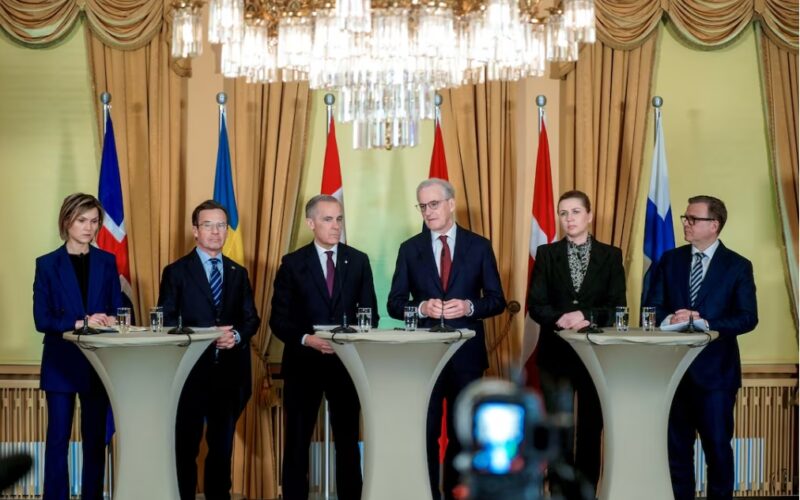
Oslo, Norway (Rajeev Sharma)— In a strategic pivot aimed at securing the increasingly volatile High North, Canada and its Nordic allies have launched a new “Middle-Power Defense Initiative” to coordinate military procurement and Arctic security. The meeting, involving leaders from Canada, Norway, Sweden, Finland, Denmark, and Iceland, focuses on building a unified front to protect shared interests in the Arctic Circle as global tensions and melting ice reshape the region’s geopolitics.
The dialogue comes as Prime Minister Mark Carney seeks to transition Canada from what he described as “piecemeal” defense spending to a robust, integrated northern strategy. By aligning with the Nordic countries—all of whom are now NATO members following Sweden and Finland’s recent accession—Canada aims to leverage collective bargaining power to acquire specialized high-latitude military technology.
Key Areas of Procurement Collaboration
The “Middle-Power” meet-up prioritized the joint acquisition of assets specifically designed for extreme cold-weather environments:
- Undersea Surveillance and Submarines: Discussions centered on the joint procurement of conventionally powered, ice-capable submarines and autonomous underwater vehicles (AUVs) to monitor transit through newly accessible shipping lanes.
- Arctic Over-the-Horizon Radar: Following Canada’s recent $6.7-billion investment in radar technology, leaders discussed integrating these systems with Nordic early-warning networks to create a seamless “Arctic Shield.”
- Next-Generation Drones: The group is exploring a shared platform for long-range, high-altitude surveillance drones capable of operating in the geomagnetic interference typical of the North Pole.
- Icebreakers and Supply Vessels: Joint ventures for the construction of multi-purpose polar vessels are being explored to reduce individual national costs and ensure interoperability during search-and-rescue or defense operations.
The “Middle-Power” Strategy
The alliance represents a deliberate effort by these nations to assert their sovereignty without solely relying on the military-industrial complex of the United States. By forming a “middle-power” bloc, these countries hope to:
- Reduce Technological Dependency: Build sovereign capabilities in satellite communications and cold-weather aviation.
- Economic Resilience: Direct defense spending toward domestic industries within the alliance, fostering a “Nordic-Canadian” tech corridor.
- Diplomatic Leverage: Present a unified voice within NATO and the Arctic Council regarding Russian and Chinese ambitions in the region.
Strategic Context: A Crowded Arctic
The urgency of the meeting is underscored by the ongoing conflict in West Asia and the resulting shift in global trade routes. With the Strait of Hormuz facing frequent disruptions, the Northern Sea Route and the Northwest Passage are becoming increasingly attractive—and contested—alternatives.
“Middle powers can no longer afford to be spectators in the Arctic,” a Canadian diplomatic source stated. “This partnership ensures that those who actually live in the North are the ones defining its security architecture.”
