

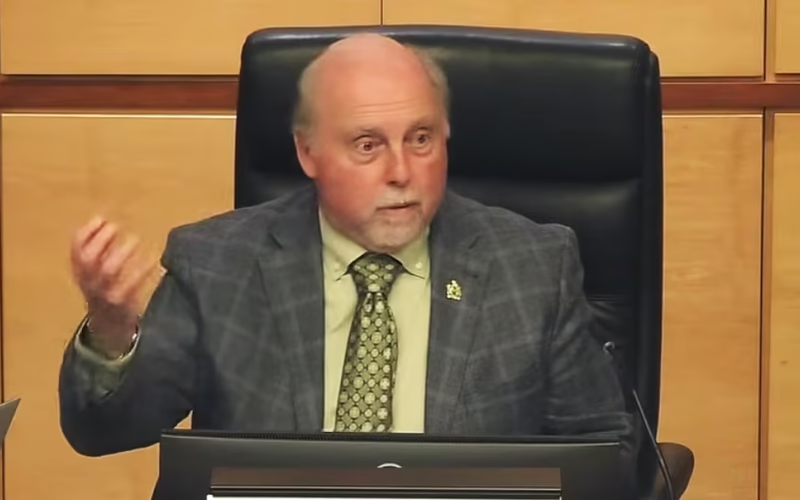
Niagara, Ontario (Rajeev Sharma) — In a sudden and dramatic exit from municipal politics, Niagara Regional Chair Bob Gale resigned his post late Wednesday, March 11, 2026, just hours after local anti-racism groups went public with evidence that he owned a signed copy of Adolf Hitler’s Mein Kampf. The resignation was tendered to Ontario Municipal Affairs Minister Rob Flack, who accepted it effective immediately.
The controversy was ignited by a joint statement from the Niagara Region Anti-Racism Association (NRARA) and Justice 4 Black Lives Niagara. The groups produced a 2010 invoice showing Gale purchased the book—inscribed by Hitler to “close friend” Max Sauerteig—at an auction for $6,345 USD. While Gale is a well-known collector of historical artifacts, the possession of “the most notorious piece of antisemitic hate” by the region’s top political official proved to be a political lightning rod that his administration could not survive.
The “Passionate Historian” Defence
In his formal resignation letter, Gale did not explicitly name the book but referred to himself as a “passionate historian” who owns a vast collection of art and artifacts. He defended his ownership as an interest in preservation rather than ideology, noting that his archives include:
- An 1859 letter from anti-slavery advocate John Brown.
- Personal letters from George Washington and Winston Churchill.
- Various documents from the Vatican archives.
Gale’s appraiser, Jon Jouppien, supported this view, stating the collection is worth millions and was curated in the “sincere interest of history.” Jouppien argued that Gale was merely following the tradition of 19th-century museum builders who preserved rare, albeit controversial, items.
Backlash and Political Friction
The timing of the whistleblowing was particularly precarious for Gale, who was already under fire for a polarizing proposal to amalgamate Niagara’s 12 municipalities into a smaller, centralized government model. In his letter, Gale blamed the controversy on a “vocal minority” and claimed a member of the “communist party” had circulated the document to protect their “fiefdoms and addiction to power.”
However, activists remained unmoved by the historical preservation argument. Saleh Waziruddin of the NRARA noted that with white supremacist groups becoming increasingly bold in the Niagara region, it was “untenable” for a public official to hold an authenticated signature of a genocidal dictator. The groups had even urged Gale to destroy the book before his resignation was announced.
What Happens Next?
Gale’s departure leaves a leadership vacuum at the Niagara Region at a time when its municipal structure is a subject of intense provincial debate.
- The Interim Chair: The Niagara Regional Council will likely meet in the coming days to appoint an interim chair or determine the process for a new provincial appointment.
- Amalgamation Pause: With Gale’s exit, his controversial push for a “one- or four-city model” for Niagara is expected to stall, as the regional council had already voted to curb his actions on the matter last month.
Minister Rob Flack, who originally appointed Gale in December 2025 citing his “strong record of public service,” has not yet commented on who might succeed him.
