

Ottawa (Rajeev Sharma): Canadian motorists are facing immediate pressure at the pumps this week as North American oil markets react to a significant escalation of conflict in the Middle East. Following a joint military operation by the U.S. and Israel against Iran on Saturday, concerns over the stability of global energy supply chains have sent crude prices on a volatile upward trajectory.
The primary focus for market analysts is the Strait of Hormuz, a narrow yet vital waterway on Iran’s southern border. Currently, approximately 20 per cent of the world’s crude oil passes through this chokepoint. Over the weekend, several tankers were reportedly struck by projectiles and drones, prompting Iran’s Revolutionary Guard to warn shippers away from the area. Consequently, over 150 commercial vessels have dropped anchor in the Persian Gulf to avoid collateral damage, effectively stalling the flow of roughly 15 million barrels of oil per day.
Experts suggest that the duration of any disruption will be the deciding factor for long-term retail prices. Rory Johnston, founder of Commodity Context, noted that while a closure lasting days might only be a “blip,” a sustained disruption stretching into weeks or months would be a “much more serious factor.” Even with alternative infrastructure to bypass the strait, analysts at Rystad Energy estimate a net loss of 8 to 10 million barrels per day if the situation does not de-escalate.
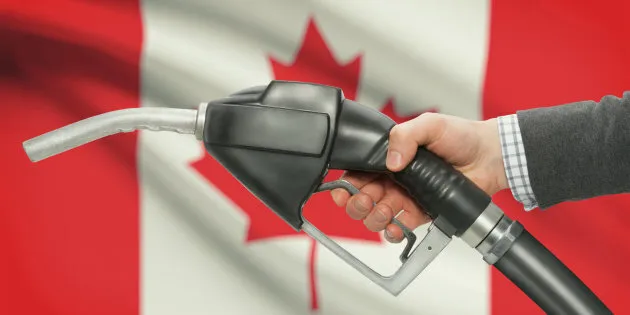
In Canada, retail gas prices reached an average of 135.3 cents per litre by Monday morning, up from 128.8 cents just a month ago. While these figures remain lower than the 151.4 cents recorded this time last year, analysts at GasBuddy warn that seasonal trends combined with geopolitical premiums could drive prices significantly higher in the coming days.
Interestingly, the Canadian oilpatch may find itself in a unique position. According to Johnston, Canada’s relative geopolitical stability during such periods of volatility is often “considered a benefit” to international buyers, potentially boosting the domestic energy sector even as consumers feel the pinch at the pump. As of midday Monday, Brent crude reached a peak of $78.04 US, while West Texas Intermediate remained elevated at $70.60 US, with some analysts speculating that prices could spike to $100 US a barrel if regional production is directly threatened.
