

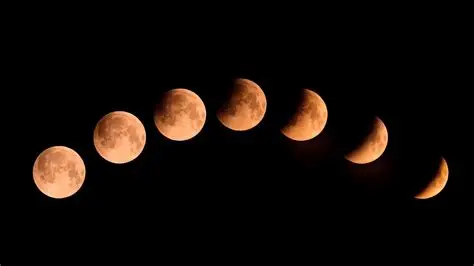
Shillong (Gurpreet Singh): Residents across Meghalaya are preparing for a spectacular celestial event on Tuesday evening, March 3, 2026, as a total lunar eclipse often referred to as a “Blood Moon” will be visible in the region. Astronomers and the India Meteorological Department (IMD) have confirmed that the northeastern states, including Meghalaya, are among the best locations in India to witness the final stages of this rare phenomenon.
According to IMD officials, the moon is expected to rise in Shillong at approximately 5:23 PM, while the totality phase- the period when the moon is completely covered by Earth’s darkest shadow is slated to end shortly after at 5:33 PM. Although the total phase will be brief for observers in India, the partial and umbral stages will continue until roughly 6:48 PM, providing a viewing window of about one hour and 25 minutes from moonrise. The reddish hue characteristic of a “Blood Moon” is caused by sunlight bending through the Earth’s atmosphere and scattering blue light, leaving only the longer red wavelengths to reach the lunar surface.
Weather conditions in Meghalaya appear highly favourable for skywatchers. Current forecasts suggest generally clear to partly cloudy skies over Shillong and surrounding areas, which should ensure minimal obstruction. Experts have noted that unlike a solar eclipse, a lunar eclipse is completely safe to view with the naked eye and does not require any special filters or protective glasses. For the best experience, residents are encouraged to find a location with a clear view of the eastern horizon around sunset.
This event is particularly significant as it marks the last total lunar eclipse that will be visible from India until late 2028. It also coincides with the vibrant festival of Holi, creating a unique intersection of scientific interest and cultural celebration. Local astronomy enthusiasts and students have already begun planning gatherings on rooftops and open hills to capture photographs and witness what is being described as one of the most striking astronomical events of the decade.
