

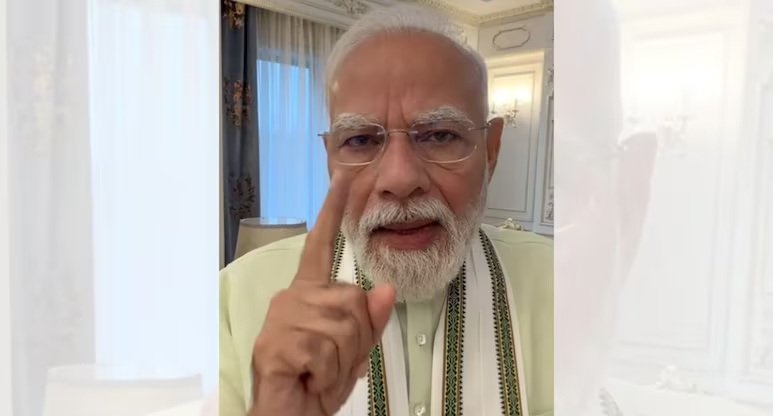
New Delhi (Rajeev Sharma): India’s stronger-than-expected economic performance has provided Prime Minister Narendra Modi an opportunity to turn the spotlight on the country’s growth story while taking a swipe at his political opponents.
Addressing the nation from Kyrgyzstan, where he is participating in the Shanghai Cooperation Organisation summit, Modi welcomed the latest GDP figures showing 7.8 per cent growth in the April-June quarter.
The numbers, he said, were particularly significant given the uncertainty facing the global economy. Conflicts, supply-chain disruptions and instability in international markets have created challenges for economies worldwide, yet India has continued to expand at a rapid pace.
Modi credited the performance to the efforts of ordinary citizens rather than presenting the figure as merely a government achievement. He described the growth rate as evidence of the country’s collective determination and resilience.
But his message quickly moved from economics to politics.
Taking a dig at critics whom he accused of creating an atmosphere of pessimism, Modi referred to an “echo of lies” being spread within the country. His choice of words was seen as a pointed reference to the BJP’s recent attacks on Rahul Gandhi and the Congress leader’s political campaign.
The BJP has previously branded Gandhi’s campaign-related claims as part of what it called “Jhooth Ki Goonj”. The party has disputed several statements made by the Congress leader during public events, categorising some as false and others as misleading.
The latest exchange adds another layer to the continuing political contest between the BJP and Congress, with economic performance increasingly becoming an important part of the government’s argument against its critics.
Modi shifts focus to domestic consumption
Beyond the political message, the Prime Minister used the occasion to renew his appeal for greater economic self-reliance.
Modi called on citizens to choose Indian destinations for holidays and weddings, arguing that such spending could help businesses and workers within the country. His “Vocal for Local” message also encouraged consumers to give preference to domestically produced goods.
He promoted the idea of holding weddings in India rather than travelling overseas for such events and urged citizens to avoid purchases that were not necessary. The broader message was that individual consumer choices could contribute to strengthening the domestic economy.
The Prime Minister connected this approach with his vision of an “Atmanirbhar Bharat”, saying that greater reliance on Indian production would help the country become more resilient when international disruptions occur.
Economy beats RBI projection
The latest figures show that India’s economic momentum remained strong even though quarterly growth eased from the 8.6 per cent recorded in the preceding quarter.
More importantly, the 7.8 per cent expansion surpassed the Reserve Bank of India’s projection of 7 per cent for the April-June period.
The result comes at a time when geopolitical tensions and uncertainty over energy markets have raised concerns about the outlook for global growth. For India, however, the latest data provide evidence that domestic economic activity has so far remained relatively robust.
Modi’s response suggests that the government intends to use the numbers not only to underline India’s economic strength but also to reinforce its broader political narrative: that sustained growth, domestic production and self-reliance should remain central to the country’s development agenda.
The immediate challenge, however, will be maintaining that pace in the quarters ahead as external risks continue to evolve.
