

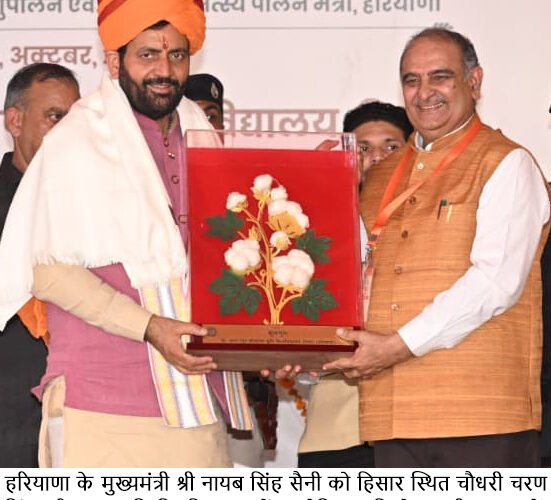
Hisar (Balwinder Singh)— Emphasizing the urgent need to balance agricultural productivity with natural resource conservation, Haryana Chief Minister Nayab Singh Saini on Thursday stated that adopting sustainable cotton farming, crop diversification, and water-saving techniques is crucial to safeguarding the farming sector for future generations.
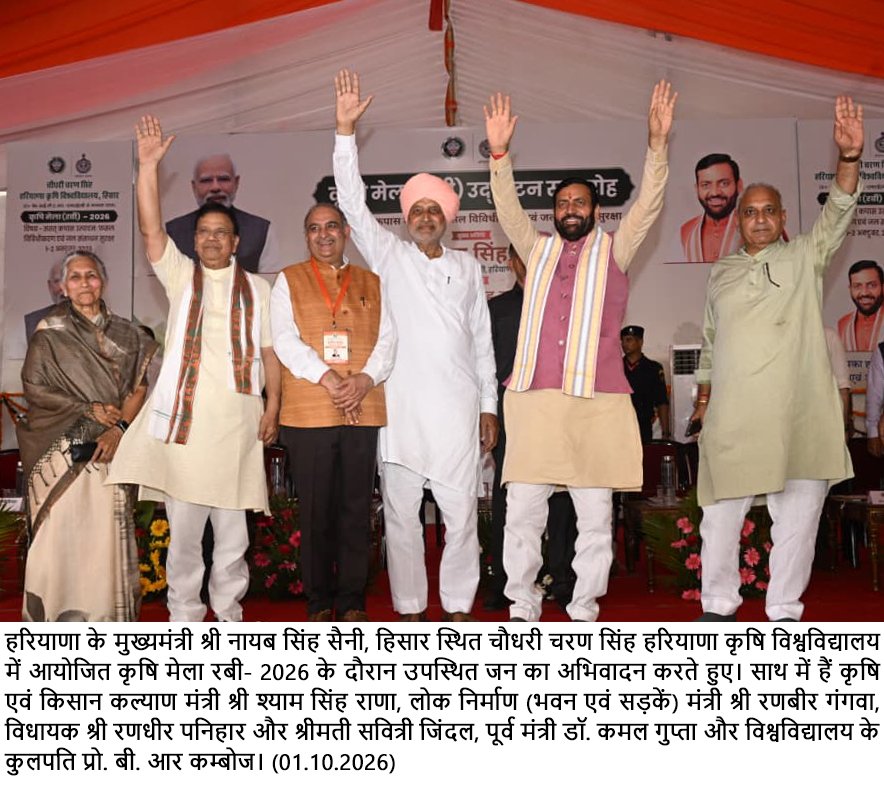
Inaugurating the two-day Rabi Krishi Mela at Chaudhary Charan Singh Haryana Agricultural University (HAU) in Hisar, the Chief Minister inspected modern farming exhibits and interacted with scientists, innovators, and progressive growers. Saini noted that mechanization, such as automated cotton pickers that harvest an acre within an hour while cutting labour requirements in half, will prevent a decline in sown areas for labour-intensive crops like cotton and sugarcane.
Highlighting the economic significance of cotton across Sirsa, Fatehabad, and Hisar, Saini referred to the cash crop as “white gold” and urged agricultural researchers to develop pest-resilient varieties suited to shifting climate patterns. The state has already organized 257 field schools and 167 farmer fairs to train over 7,000 growers in integrated pest management and cost-effective cultivation techniques.
To combat groundwater depletion, the Chief Minister reiterated the administration’s push away from water-intensive monoculture. Under the “Mera Pani-Meri Virasat” scheme, the state provides 8,000 rupees per acre to farmers who replace paddy with alternative crops or leave land fallow. Saini reported that 166.34 crore rupees in financial assistance has been disbursed to 1.59 lakh farmers across 2.34 lakh acres. Additionally, Haryana provides an 85 percent subsidy on micro-irrigation installations and farm pond construction, alongside commissioning 20 of 27 planned projects utilizing treated sewage effluent for agricultural supply.
Soil health preservation remains another focal priority, with the state having issued 1.06 crore Soil Health Cards and established 17 specialized testing labs, 54 mandi testing facilities, and 240 academic testing setups. On direct financial support, Saini detailed that the state ensures minimum support price purchases across all primary produce, having distributed 7,881.60 crore rupees under PM-Kisan and over 1.85 lakh crore rupees in direct procurement payouts over the past 12 seasons.
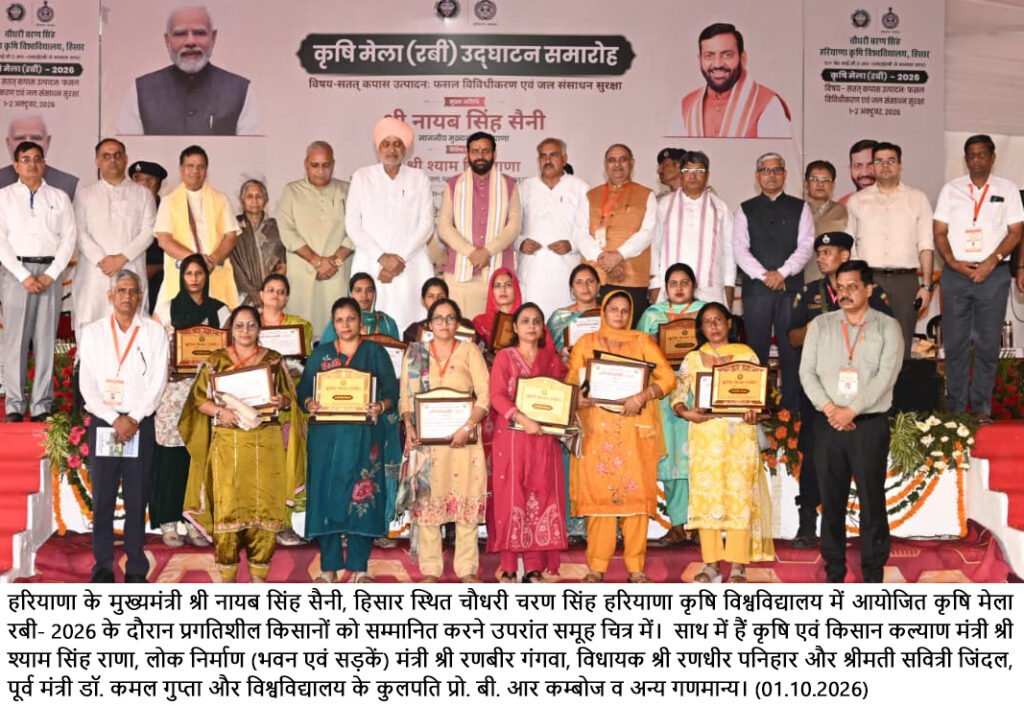
Saini also inaugurated the newly constructed Deen Dayal Upadhyaya Centre of Excellence for Organic Farming at HAU, developed at a cost of 9.94 crore rupees to serve as a research, training, and guidance hub for chemical-free agriculture. During the event, the Chief Minister felicitated 45 progressive farmers—comprising 30 men and 15 women—for their exemplary contributions to crop diversification, organic farming, stubble management, dairy, and allied agricultural enterprises.
State Agriculture Minister Shyam Singh Rana urged growers to leverage cutting-edge technology while preserving soil and water integrity, and HAU Vice-Chancellor Prof. B.R. Kamboj highlighted the university’s development of indigenous cotton varieties, HAU BT-12 and BT-13, and mustard hybrid 2101 alongside online seed distribution initiatives. Cabinet Minister Ranbir Gangwa, Hisar MLA Savitri Jindal, Nalwa MLA Randhir Panihar, and several senior administrative officials attended the gathering.
