

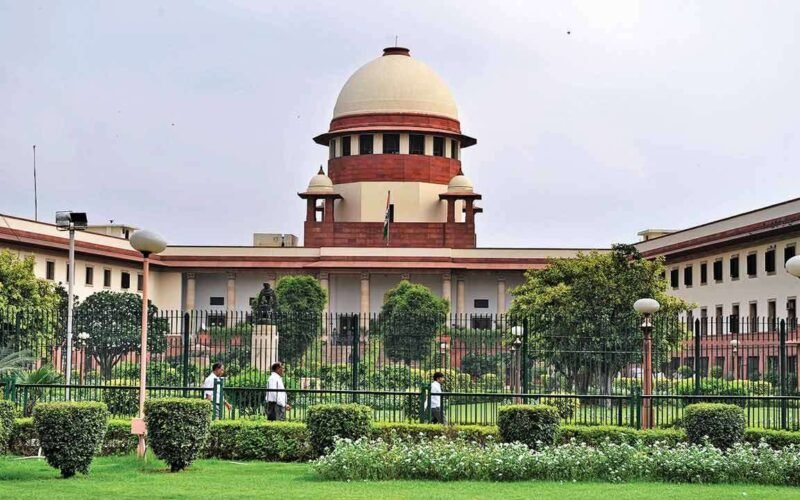
New Delhi (Gurpreet Singh): The Supreme Court of India on Thursday issued formal notices to the Union Government, the Delhi Police, the Delhi Metro Rail Corporation, and the Government of the National Capital Territory of Delhi in response to a petition challenging the shutdown of 17 metro stations during demonstrations in July. A three-judge bench presided over by Chief Justice of India Surya Kant, alongside Justices Joymalya Bagchi and V. Mohana, took cognizance of the plea questioning the legal authority, procedural validity, and proportionality of suspending essential urban transit operations.
The petition, moved by advocate Sparsh Kant Nayak, arose following severe commuter disruption in central Delhi when transport authorities shut down key transit points around Jantar Mantar—including several closures on July 20 and July 22—amid public protests organised by the Cockroach Janata Party. The sudden closures, combined with extensive police barricades, triggered citywide gridlock that left thousands of passengers stranded for hours and forced office workers, lawyers, and students onto costlier detour routes.
Arguing before the bench, counsel for the petitioner contended that the shutdown encroached upon the fundamental constitutional rights of the broader public to freedom of movement. Counsel pointed out that the Metro Railways (Operation and Maintenance) Act contains no statutory provision empowering authorities to shutter metro stations as an administrative measure during public agitations. Furthermore, the plea stressed that no formal administrative or executive order had been gazetted or issued under any specific governing statute. Instead, transit closures were communicated to the general public solely through impromptu service updates and advisory posts on the social media platform X, raising questions regarding official transparency and executive discretion.
During the hearing, the bench discussed the legal mechanics of vehicular regulation, with the court observing that restrictions on road transit are typically ordered by a Commissioner of Police or Superintendent of Police pursuant to police enactments. Justice Joymalya Bagchi noted that while courts have traditionally deferred to the executive on matters concerning law and order, judicial intervention becomes essential if executive discretion is exercised in a grossly disproportionate manner. Observing that rigid standard operating procedures during fluid public order situations can often be an illusion, the bench stated that it would examine whether the administrative discretion exercised during the July shutdown fell within reasonable limits and served legitimate public interests. The apex court has directed the respondents to place their formal replies on record ahead of the next hearing.
