

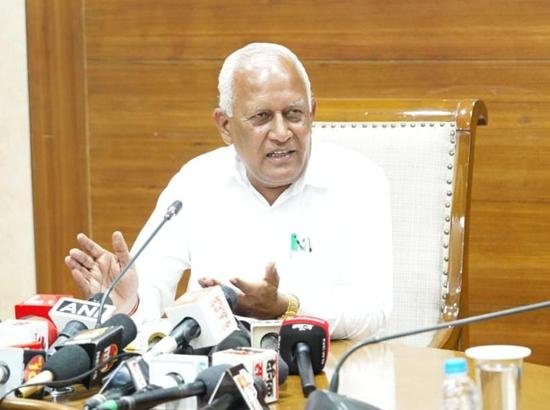
Chandigarh (Gurpreet Singh): Punjab Water Resources Minister Barinder Kumar Goyal on Tuesday announced two major canal irrigation initiatives worth a combined ₹100.65 crore to provide assured surface-water irrigation to over 90,000 acres of agricultural land, reduce farmers’ dependence on groundwater and strengthen Punjab’s irrigation infrastructure. The initiatives include a ₹64.11 crore concrete lining project for the 1-R Distributary System and a ₹36.54 crore Kapuri Lift Irrigation Scheme, which will bring canal water to 20,719 acres across 20 villages in Patiala district for the first time.
Addressing a press conference at Punjab Bhawan, Water Resources Minister Barinder Kumar Goyal said, “The Bhagwant Mann Government has prioritised the restoration, modernisation and expansion of the canal irrigation network to ensure reliable water supply to farmers while addressing the critical challenge of groundwater depletion. The farmers of Punjab have been feeding the nation for decades. Our responsibility is to ensure that they receive assured water for their fields. The Mann Government is restoring the canal network and taking surface water to areas which have remained dependent on groundwater for generations.”
The Water Resources Minister said the Government has approved the 1-R Distributary System Concrete Lining Project, estimated at ₹64.11 crore, to reconstruct and enhance the carrying capacity of the approximately 60-year-old distributary. The project will restore and ensure adequate irrigation water supply to its existing Culturable Command Area of 69,967 acres, benefiting approximately 80 villages across Fatehgarh Sahib and Patiala districts.
He said the existing carrying capacity of the distributary would be increased from 154.50 cusecs to 248.69 cusecs through concrete lining. The project provides for side lining along the initial stretch and both side and bed lining along the remaining length. An allocation of ₹40 crore has been made for executing the project during the current financial year. “The 1-R Distributary was designed around six decades ago for a water allowance of 2.04 cusecs per 1,000 acres. With the Government increasing the water allowance to 3.05 cusecs per 1,000 acres, strengthening its carrying capacity has become essential,” said the Minister.
He said the existing unlined channel had deteriorated over the years, with leakage and seepage resulting in substantial water losses and affecting efficient conveyance and uninterrupted supply. The concrete lining would address these deficiencies, enhance carrying capacity and ensure more reliable canal irrigation to farmers.
The Water Resources Minister said the Kapuri Lift Irrigation Scheme, formulated at a cost of ₹36.54 crore, would provide assured surface-water irrigation to 20,719 acres of agricultural land across 20 villages in Patiala district along the Haryana border. “These areas had historically remained without canal-water facilities, leaving farmers heavily dependent on groundwater for irrigation,” he added.
The 20 villages to benefit under the scheme include Sarala Kalan, Kamalpur, Kapuri, Lachhru Khurd, Sautan, Rampur, Chamaru, Taharpur, Jharwan, Harpalan, Narayangarh, Loh Simbli, Darwa, Shamaspur, Dharmgarh, Madian, Kami Khurd, Untsar, Nanheri and Sheikhpura.
Under the scheme, water will be lifted and conveyed through a network of distribution pipelines directly to agricultural fields. The project will be executed in phases, with ₹4 crore proposed for expenditure during the first phase in the current financial year. “The Kapuri Lift Irrigation Scheme addresses a long-standing demand of farmers in an area where canal-water facilities were historically unavailable. For the first time, 20,719 acres will receive assured canal-water irrigation. This will reduce pressure on groundwater and strengthen the sustainability of agriculture,” said Minister Barinder Kumar Goyal.
The Cabinet Minister said the Government has increased the water allowance of the Bhakra Main Line system from 2.04 to 3.05 cusecs per 1,000 acres to ensure fuller utilisation of Punjab’s share of canal water and address the growing problem of groundwater depletion.
He said the revised water allowance had increased the required carrying capacity of channels by approximately 1.5 times, making the strengthening and modernisation of the existing irrigation infrastructure essential. Accordingly, the 1-R Distributary project had been designed to meet the enhanced irrigation requirements.
Barinder Kumar Goyal said both initiatives were part of the Mann Government’s broader strategy to replace excessive groundwater extraction with dependable surface-water irrigation. Improved canal-water availability would reduce farmers’ dependence on tubewells, help conserve groundwater and lower the power subsidy requirement for agricultural electricity supply.
He said the Kapuri Lift Irrigation Scheme was particularly significant as it would extend canal-water facilities to areas that had remained dependent on groundwater for generations, thereby reducing the burden of groundwater extraction and making agriculture more sustainable.
₹7,500 Crore Invested In Strengthening Canal Infrastructure
The Water Resources Minister said the Punjab Government had invested approximately ₹7,500 crore in strengthening the state’s canal irrigation infrastructure. Around 14,000 kilometres of watercourses had been constructed and pipelines laid, while more than 19,000 watercourses had been restored.
He said the Bhagwant Mann Government was continuing to revive deteriorated canal infrastructure and ensure that irrigation water reached even the tail-end areas of the distribution network. “Punjab’s water security depends on taking canal water to the fields. Our objective is not merely to expand irrigation infrastructure but to ensure that every possible drop of available surface water is put to productive agricultural use,” said the Minister.
Highlighting Punjab’s contribution to national food security, the Cabinet Minister said groundwater conservation and sustainable irrigation were matters of national importance, given the state’s significant contribution to the country’s foodgrain pool.
He said Punjab contributed around 48% of wheat and 21% of rice to the Central Pool despite accounting for less than two per cent of the country’s geographical area. “If Punjab’s agriculture suffers, the country’s food security is also affected. By expanding canal irrigation and reducing pressure on groundwater, we are protecting Punjab’s agricultural future as well as contributing to the country’s food security,” said the Minister.
The Minister said the two initiatives marked another significant step towards the Mann Government’s objective of ensuring assured canal-water supply, reducing dependence on groundwater and building a more efficient, sustainable and robust irrigation system across Punjab.
