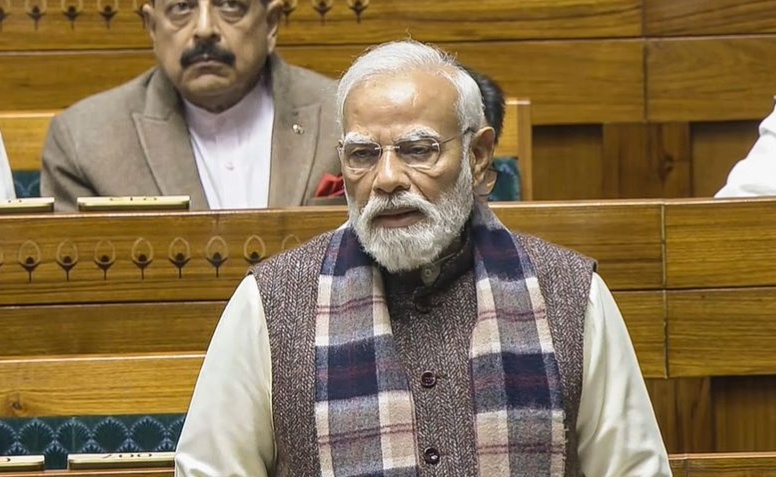
New Delhi, December 8— Prime Minister Narendra Modi sparked a major political flashpoint on Monday after alleging that India’s first Prime Minister, Jawaharlal Nehru, “betrayed” Vande Mataram by diluting its spirit under pressure from the Muslim League and the Congress’ then policy of appeasement.
Speaking during a special discussion in the Lok Sabha on the 150th Anniversary of the National Song, the Prime Minister revisited historical events to argue that the Congress leadership compromised on the national song at a crucial moment in India’s freedom struggle.
PM Modi claimed that Vande Mataram—first written by Bankim Chandra Chatterjee in 1875—had united Indians across regions, yet became entangled in political calculations. He said Muslim League leader MA Jinnah launched an intensified opposition to the song on October 15, 1937, in Lucknow. Just five days later, according to Modi, Nehru wrote to Netaji Subhas Chandra Bose expressing concern that the song’s Anandmath background could “irritate the Muslims.”
Quoting from the letter, Modi said Nehru associated himself with Jinnah’s objections instead of defending the national song. The Prime Minister added that the Congress Working Committee’s subsequent decision—on October 29, 1937—to adopt only the first two stanzas of Vande Mataram and drop the rest amounted to “truncating” the song to appease the Muslim League.
Modi argued that this episode revealed a pattern of political concessions that later contributed to accepting the Partition of India. He said that under the “compulsions of appeasement,” the Congress not only compromised on Vande Mataram but also took decisions that shaped India’s geopolitical fate.
The Prime Minister also invoked Mahatma Gandhi’s early praise for Vande Mataram, citing Gandhi’s 1905 writings in Indian Opinion, where he described it as a unifying force during the Swadeshi movement and “sweeter than the songs of other nations.”
Modi criticised the Congress for continuing to create controversy around the national song even today, saying its political choices had pushed the organisation from the Indian National Congress to what he termed the “Muslim Maoist Congress (MMC).” The Congress, however, dismissed the accusations, stressing that Nehru had relied on Rabindranath Tagore’s guidance in limiting the adopted stanzas.
Amid applause from the treasury benches, the Prime Minister said history must inform the younger generations about the forces that “dragged Vande Mataram into controversy.” He framed the national song as a source of resilience, saying it inspired India during crises—from food shortages to wars and even the Covid-19 pandemic.
Modi concluded that Vande Mataram would continue to strengthen the country’s resolve on the path to Viksit Bharat by 2047, urging all citizens to embrace the spirit of swadeshi and national unity.
PM Modi Accuses Nehru of ‘Betraying’ Vande Mataram, Says Congress Chose Appeasement Under Pressure from Muslim League
 0 Comments