

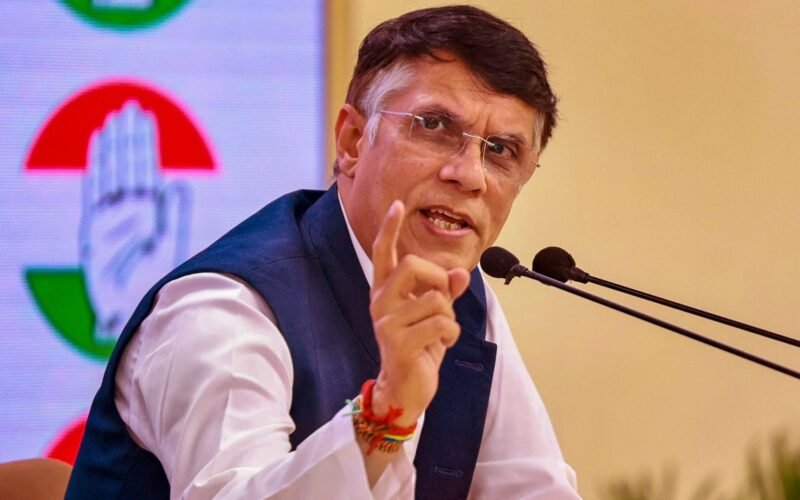
New Delhi (Rajeev Sharma): Congress leader Pawan Khera has responded to US President Donald Trump’s recent statement expressing support for India in the event of an attack, saying New Delhi should evaluate such assurances by considering past developments and the broader geopolitical context.
Speaking to the media, Khera referred to Trump’s comments made during his meeting with Prime Minister Narendra Modi in France, where the US President said America would stand by India if it faced external aggression. While acknowledging the significance of diplomatic relations, the Congress leader argued that foreign policy should be shaped by actions rather than public declarations.
Khera recalled the developments surrounding Operation Sindoor, claiming that a ceasefire announcement made by the United States during that period remains an important factor in assessing Washington’s role in regional affairs. He suggested that India should not overlook previous experiences while evaluating statements made by international leaders.
The Congress spokesperson also referred to President Trump’s meeting with Pakistan’s Field Marshal Asim Munir, stating that maintaining close ties with multiple countries in the region reflects the complex nature of global diplomacy. In such circumstances, he said, expecting unconditional support for India would be unrealistic.
According to Khera, international partnerships are often guided by strategic interests, and countries generally pursue policies that align with their own priorities. He maintained that India should continue to strengthen its independent foreign policy while engaging constructively with global powers.
Trump’s remarks came during a bilateral interaction with Prime Minister Modi on the sidelines of the G7 Summit, where the two leaders discussed defence cooperation, trade and regional security. His statement that the United States would assist India if attacked drew considerable attention and was seen by many as a reflection of the growing strategic partnership between the two democracies.
However, Khera’s response highlighted the opposition’s cautious approach towards interpreting such assurances, arguing that diplomatic relationships should be judged by long-term conduct and policy decisions rather than individual statements.
The exchange has sparked fresh political debate over India’s engagement with major international partners and the extent to which strategic commitments made on global platforms should influence national security calculations.
As India continues to expand its diplomatic outreach and strengthen ties with leading global powers, differing political viewpoints on the nature of these partnerships are likely to remain part of the broader discussion on the country’s foreign policy and strategic priorities.
