

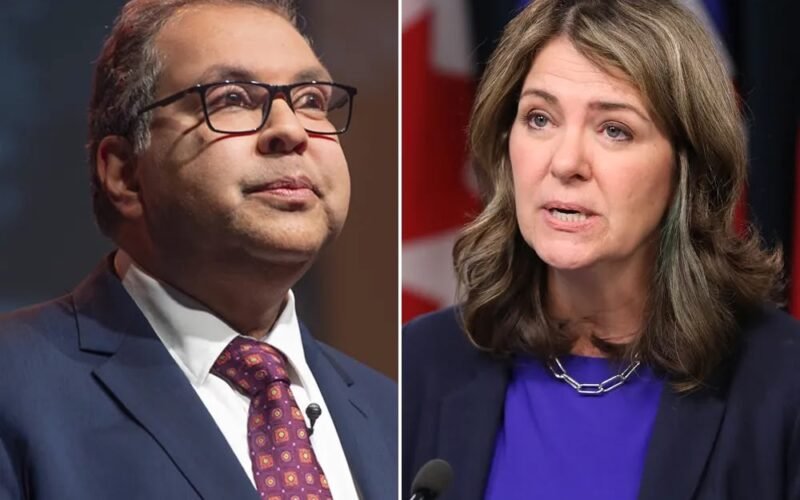
Calgary (Rajeev Sharma) : Alberta Premier Danielle Smith is facing increased public scrutiny following the release of a new ThinkHQ Public Affairs survey showing lower approval ratings for her leadership. The findings come after the province’s October 19, 2026, referendum and provide a snapshot of public opinion toward Alberta’s two main political leaders.
The survey, conducted online among 1,160 Albertans between October 21 and 27, found that 39 per cent approved of Smith’s performance, while 59 per cent disapproved. Among those surveyed, 49 per cent strongly disapproved. NDP Leader Naheed Nenshi received 44 per cent approval and 48 per cent disapproval. Neither leader received majority approval.
The regional findings are particularly notable in Calgary. According to ThinkHQ, Nenshi’s approval rating stands at 48 per cent across the greater Calgary area, compared with 37 per cent for Smith. Within Calgary city limits, Nenshi reportedly holds a 16-percentage-point approval advantage. ThinkHQ president Marc Henry has identified moderate suburban voters as an important area of changing public opinion.
However, the figures measure leadership approval, not direct voting intentions. They should not be interpreted as a prediction of the next provincial election. The survey also indicates that Smith retains considerable support among previous UCP voters, with approximately 73 per cent of those who supported the party in the 2023 provincial election continuing to approve of her performance.
The referendum has also generated public debate about government priorities and the use of public resources. In a separate survey released by Pollara Strategic Insights on October 17, 70 per cent of Albertans described the referendum process as a waste of time and money. This finding reflects respondents’ opinions and does not independently establish the referendum’s financial cost or its impact on the government’s overall performance.
The referendum question itself concerned whether Alberta should begin the legal process toward a future binding referendum on separation; it was not a direct vote on immediate independence. Elections Alberta subsequently published the official results of the October 19 vote.
The ThinkHQ survey carries a stated margin of error of plus or minus 2.9 percentage points, 19 times out of 20. As with all public-opinion research, the findings represent the views of respondents during the survey period and may not reflect subsequent changes in public sentiment.
WHAT THE POLL INDICATES
The latest findings highlight public dissatisfaction with the premier’s performance, differences in leadership approval between urban and suburban regions, and continuing debate over the referendum. They also show that both major party leaders face substantial disapproval.
For Alberta’s political leadership, the findings raise important questions about public priorities, government accountability, economic concerns and the province’s relationship with the rest of Canada. Whether these opinions translate into changes in voter behaviour will become clearer through subsequent polling and the next provincial election.
National Times Media presents these findings as reported survey results and does not endorse any political party or leader.
