

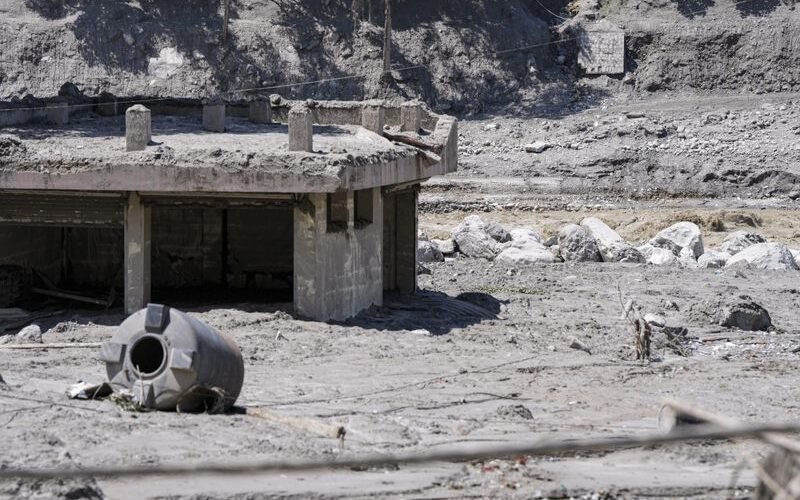
Kathmandu (Rajeev Sharma): Nepal’s devastating flash floods have left a growing trail of destruction, with the death toll climbing to 1,356, while rescue agencies continue searching for thousands of people still unaccounted for.
According to Nepal’s National Disaster Risk Reduction and Management Authority (NDRRMA), 4,994 people remain missing, including at least 589 foreign nationals. Rescue teams have so far managed to bring 13,396 people to safety.
The catastrophe began on August 26 after an ice-and-rock avalanche close to the Nepal-Tibet border triggered a massive surge of water. The Bhotekoshi River carried the floodwaters into areas farther south, where entire communities were affected. Homes, vehicles, roads and bridges were swept away, while several hydropower facilities also suffered extensive damage.
Hundreds of bodies recovered across several districts
The scale of the disaster has become increasingly clear as recovery teams continue to find bodies downstream.
NDRRMA figures show that Chitwan recorded 363 recovered bodies, followed by Nawalparasi East with 223 and Nawalparasi West with 221. Nuwakot reported 197 deaths, while 169 bodies were recovered in Rasuwa. Gorkha, Dhading and Tanahu recorded 75, 70 and 38 deaths respectively.
However, authorities face another major challenge: identifying the victims.
Only 98 recovered bodies had been formally identified and returned to their families by Monday. Many of the remains were badly damaged after spending time in fast-moving water and mud. In several cases, only parts of bodies have been recovered, making identification even more difficult.
DNA testing being used to identify victims
Nepal Police has begun collecting DNA samples from relatives of people reported missing. The samples are expected to help authorities establish the identities of victims whose bodies cannot be recognised through conventional methods.
Officials said that more than 1,000 unidentified bodies have been buried after DNA samples were taken, allowing identification efforts to continue later.
Hospitals and medical centres in affected areas have also been under considerable pressure. Families of missing people have been visiting facilities with photographs of their relatives and checking displayed images in the hope of finding information about loved ones.
Damage extends beyond Nepal
The disaster has also caused significant loss of life on the Chinese side of the border. Chinese media reports have put the number of deaths in the affected region at at least 43, while more than 500 people are reportedly still missing in Tibet.
The cross-border impact of the disaster has further complicated rescue and recovery operations in the Himalayan region.
President visits flood-hit districts
Nepal President Ramchandra Paudel visited the badly affected districts of Nuwakot and Rasuwa on Monday to assess the ongoing rescue and relief operations.
Officials briefed the president on efforts to locate missing people, distribute emergency assistance and provide temporary accommodation. Rehabilitation and plans for rebuilding communities were also discussed.
After his visit, Paudel addressed the nation and urged the international community to take stronger action on climate-related challenges facing Nepal and other vulnerable Himalayan countries.
He also appealed for political unity at home, asking political parties and citizens to concentrate on helping victims rather than turning the disaster into an arena for blame and confrontation.
Nepal observes day of mourning
The country observed a national day of mourning on Monday, marking the 13th day since the disaster. Government buildings across Nepal lowered the national flag to half-mast, while Nepali diplomatic missions overseas also followed the measure.
As search teams continue working through damaged villages, river channels and debris-filled areas, families across the country remain desperate for news about missing relatives.
With thousands still unaccounted for and identification efforts progressing slowly, Nepal’s recovery operation is expected to remain a long and difficult process.
