

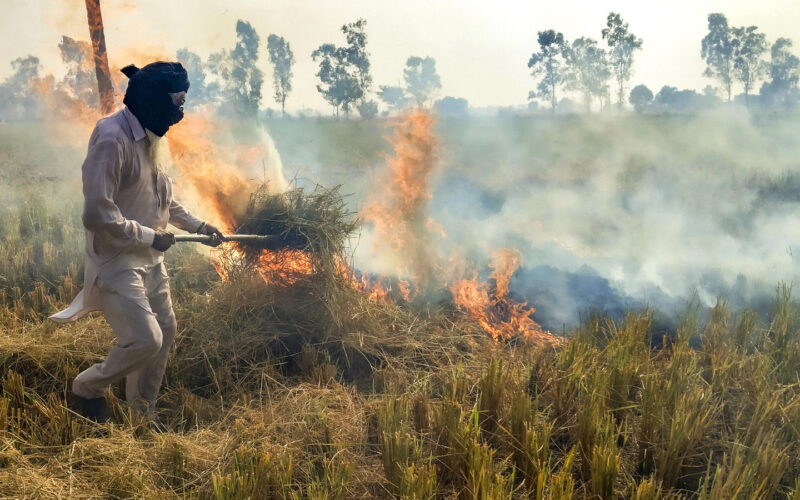
Chandigarh (Balwinder Singh): Haryana has reduced paddy stubble-burning incidents by 91 per cent since 2021, deployed 78 of the 81 mechanised road sweeping machines required under prescribed norms, redeveloped 675 km of targeted roads and strengthened pollution-control monitoring across 1,309 industries, Chief Secretary Sh. Anurag Rastogi said, highlighting the state’s multi-pronged drive to improve air quality.
Sh. Rastogi gave details of the measures being taken by Haryana after attending the High-Level Task Force meeting on management of air pollution in Delhi-NCR.
The Chief Secretary said Haryana was pursuing a coordinated strategy covering paddy-straw management, road dust, industrial emissions, vehicular pollution, construction and demolition waste, municipal solid waste and expansion of air-quality monitoring.
Haryana had achieved a 91 per cent reduction in paddy stubble-burning fire counts in 2025 compared with 2021, reflecting the impact of sustained enforcement and crop-residue management measures.
Haryana generates around 7.97 million tonnes of paddy straw, with the management plan providing for 55 per cent to be handled through in-situ methods, 33 per cent through ex-situ utilisation and 12 per cent as fodder.
The state has procured 7,950 crop-residue management machines against a target of 9,000 for the 2026 season. Ex-situ utilisation of paddy straw has also increased substantially. It stood at 1.32 million tonnes in 2023, 1.55 million tonnes in 2024 and 2.19 million tonnes in 2025, and is projected at 2.71 million tonnes in 2026.
The state plans to further strengthen surveillance by deploying about 50 drones in hotspot areas. Low-cost PM2.5 sensors are also proposed in hotspot villages, while burnt areas will be verified on the ground through an ISRO-developed mobile application.
Haryana had achieved 5.89 per cent biomass co-firing in thermal power plants up to August 2026, crossing the five per cent benchmark. Biomass co-firing in brick kilns in non-NCR Haryana has reached 21.9 per cent and is proposed to be increased to 30 per cent from November 1.
675 km roads redeveloped
The Chief Secretary said Haryana was simultaneously focusing on road dust, a significant source of particulate pollution in NCR. Of the 1,162 km of roads identified for redevelopment, 675 km have already been redeveloped, representing 58 per cent achievement.
The state is also implementing the Road Asset Management System, with emphasis on road redevelopment, repair of potholes and damaged footpaths and better management of road infrastructure.
96 per cent mechanised sweepers deployed
Haryana has deployed 78 of the 81 large and medium mechanised road sweeping machines required for roads wider than 10 metres, achieving 96 per cent deployment, Rastogi said. Only three machines remain to be deployed.
The state will also focus on smaller mechanised sweeping machines for narrower roads, litter-picking equipment and digital tracking of sweeping machines to ensure effective deployment.
The Chief Secretary said industrial pollution-control measures were also being strengthened. Haryana has 1,309 industries covered in the industrial pollution-control review framework, of which 192 have been exempted or certified as having adequate arrangements.
Of the remaining 1,117 industries requiring action on air-pollution control devices, purchase orders have been placed in 383 cases.
3,211 construction sites on monitoring portal
Rastogi said 3,211 active construction and demolition sites measuring more than 500 square metres in Haryana have been registered on the monitoring web portal. The state is strengthening dust-control compliance at construction sites, including monitoring through cameras and particulate-matter sensors.
Haryana has 1,018 electric city buses
Haryana currently has 1,018 electric city buses, against an assessed requirement of 2,900, and 1,276 charging stations, against a requirement of 2,500. The state has also identified 121 traffic-congestion points and decongested 46 of them. Further measures will focus on smoother traffic movement and reduction of vehicular emissions.
Air-quality monitoring network being expanded
Haryana currently has 22 Continuous Ambient Air Quality Monitoring Stations, while the proposed network comprises 45 stations. Three Real-Time Source Apportionment sites have also been finalised in Haryana — at Maharshi Dayanand University, Rohtak, and Indira Gandhi University, Rewari.
The Chief Secretary said Haryana would continue to intensify action ahead of winter, with particular emphasis on farm fires, road dust, industrial and vehicular emissions, waste burning and other major sources of particulate pollution.
