

Panchkula (Balwinder Singh): Haryana Chief Minister Nayab Singh Saini on Tuesday unveiled a major rural development package worth more than ₹2,697 crore and announced significant relief for families residing on village shamlat land, extending the deadline for applying for ownership rights until January 16, 2027.
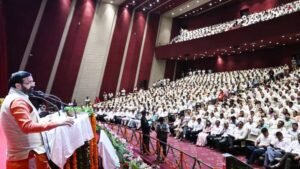
Addressing the State-Level Empowered Panchayat Programme at Indradhanush Auditorium in Panchkula, the Chief Minister said Haryana’s villages are at the heart of the state’s development strategy and called upon panchayats to play a leading role in rural progress, environmental protection, drug de-addiction campaigns and the promotion of natural farming.
The Chief Minister said families who have been living in houses built on village common land for the past 20 years can now submit applications for ownership rights under the prescribed policy until January 16, 2027. He added that eligible beneficiaries would be required to pay one-and-a-half times the 2004 collector rate for purchasing the land. The extension was granted because many eligible applicants faced documentation-related difficulties and could not apply earlier.
Announcing measures to strengthen rural sanitation, Saini said the government would provide electric tractor-trolleys, drivers and waste collection workers to improve garbage management in villages. He added that the state is also working on waste-to-energy projects.
During the event, the Chief Minister inaugurated LED street lighting projects on village peripheral roads in 179 villages across 17 districts at a cost of ₹23.21 crore. He also dedicated 350 Atal Libraries built in 17 districts at a cost of ₹44 crore.
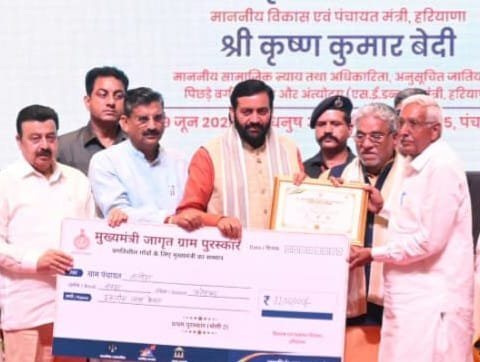
As part of the rural development package, ₹1,056.75 crore was directly transferred to Panchayati Raj institutions for development works. Six gram panchayats were honoured under the Jagrit Gram Awards for setting benchmarks in development, cleanliness and good governance, receiving a total prize amount of ₹1.66 crore.
Jandli Kalan village in Fatehabad district received ₹51 lakh, Jhinjhar village in Charkhi Dadri received ₹31 lakh, and Saha village in Ambala was awarded ₹21 lakh. In the second category, Jallopur village received ₹31 lakh, Gadli village ₹21 lakh, and Mardanheri village in Karnal district ₹11 lakh.
The Chief Minister also released the book Dharmakshetra Kurukshetra, highlighting the cultural and religious significance of Kurukshetra.
Calling villages the true strength of India, Saini said the tradition of Panch Parmeshwar has kept democracy alive at the grassroots level. He credited Prime Minister Narendra Modi’s governance philosophy of treating villages not as the final destination of development but as its starting point.
Highlighting direct benefit transfer initiatives, the Chief Minister released several welfare scheme installments during the programme. Under the Deen Dayal Lado Lakshmi Yojana, ₹207.75 crore was transferred as the eighth installment for women beneficiaries. Another ₹19.75 crore was released under the Har Ghar-Har Grihini Yojana.
More than ₹1,151.51 crore was transferred directly to beneficiaries under social security pension schemes. Students belonging to OBC and DNT categories received scholarships worth ₹23.17 crore, while ₹169.50 crore was distributed as financial assistance under the Dayalu Scheme.
Saini said empowered panchayats form the foundation of strong democracy and prosperous villages. He noted that more than 98 per cent of Haryana’s villages have achieved ODF Plus status and expressed confidence that all villages would become ODF Plus Model Villages by October 2, 2026.
He said over 2,100 Amrit Sarovars have been created across the state and highlighted the government’s decision to increase the limit for development works executed directly by gram panchayats from ₹5 lakh to ₹21 lakh.
To strengthen local governance, panchayat representatives are now entitled to travel and daily allowances equivalent to HCS officers and judicial magistrates for official and judicial duties. Panchayats are also receiving a share of stamp duty collections and two per cent of electricity consumption charges directly into their accounts.
The Chief Minister stressed that transparent recruitment policies have restored confidence among youth. He said over 3,000 young people had recently secured jobs through a merit-based process without recommendations or bribery. He further announced that 5,600 vacancies would be filled in Haryana Police, while results for examinations involving around 8,500 candidates would be declared soon.
Calling for a decisive fight against drug abuse, Saini urged sarpanches to make their villages drug-free and assist authorities in identifying traffickers. He said information related to narcotics can be reported through the state’s MANAS portal, with complete confidentiality guaranteed for informants.
He encouraged panchayats to promote sports among youth and set their sights on the 2036 Olympics. The government, he said, would provide sports equipment wherever required.
The Chief Minister also appealed to farmers to avoid stubble burning and adopt sustainable agricultural practices. He highlighted government incentives for natural farming, indigenous cow rearing and crop diversification.
Referring to efforts in the Morni region, he said agreements have been signed to promote turmeric cultivation, with farmers growing turmeric and ginger eligible for assistance of up to ₹45,000 per acre.
Saini urged sarpanches to identify economically weaker families so they can benefit from welfare schemes, including housing assistance and the PM Surya Ghar Yojana, which aims to reduce household electricity bills through rooftop solar installations.
Speaking at the event, Development and Panchayats Minister Krishan Lal Panwar said the state government plans to establish indoor gyms, modern libraries and women’s cultural centres in all 6,225 gram panchayats. He added that village-level libraries are being expanded to help rural youth prepare for competitive examinations.
Industry, Environment and Forest Minister Rao Narbir Singh appealed to panchayat leaders to eliminate the use of polythene and single-use plastics, emphasizing that environmental protection must become a mass movement.
Several sarpanches from across the state also shared their experiences during the programme, praising the government’s efforts to improve transparency, strengthen village governance and promote women’s participation through 50 per cent reservation in panchayats.
