

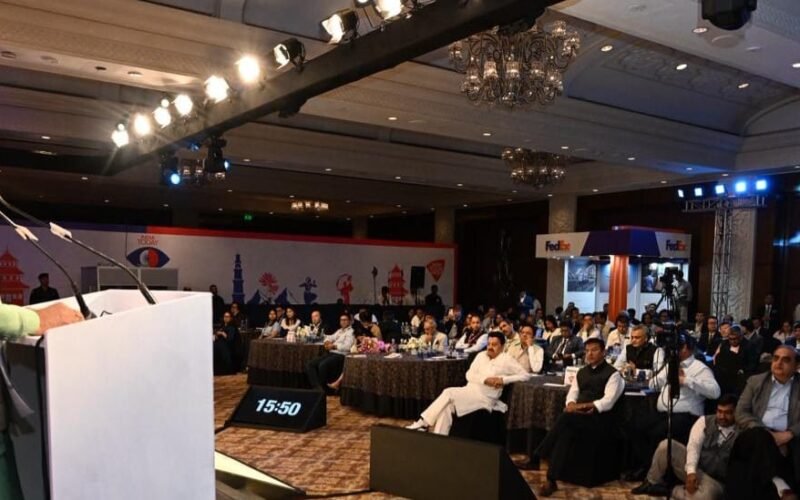
Chandigarh (Balwinder Singh): Haryana Chief Minister Nayab Singh Saini on Friday invited Japanese corporations and investors to forge strategic partnerships with the state to build a resilient, smart, and sustainable next-generation industrial ecosystem. Addressing the Indo-Japan Conclave in New Delhi alongside Haryana Industry and Commerce Minister Rao Narbir Singh, the Chief Minister emphasized that the bilateral relationship between India and Japan is anchored in deep mutual trust, operational discipline, and a shared commitment to engineering excellence. Saini stated that a trust-based partnership is vital for navigating modern economic challenges, making close integration between Japanese technology and Haryana’s manufacturing capabilities a model framework for both nations.
The Chief Minister highlighted that Haryana has emerged as the premier manufacturing and operational hub for Japanese enterprises in India, housing nearly 394 Japanese factories and over 600 commercial establishments. Recalling his official state visit to Tokyo in October last year, Saini revealed that nine prominent Japanese conglomerate groups committed to fresh investments totaling approximately 5,000 crore rupees in Haryana. He attributed this sustained investment to the state’s proactive alignment with Japanese workspace culture—which prioritizes operational stability, a disciplined workforce, and reliable supply chains—effectively rendering industrial nodes like Gurugram, Manesar, Sonipat, Bawal, and Jhajjar a “home away from home” for expatriate professionals.
To further deepen this cross-border integration, the state administration is expanding its dedicated industrial infrastructure. Saini announced that alongside the operational Japanese Industrial Townships in Jhajjar, a specialized Japanese manufacturing cluster is currently being planned for Naraingarh. Backed by world-class connectivity pipelines including the Delhi-Mumbai Express Highway, the Western Dedicated Freight Corridor, and expanding Regional Rapid Transit System networks, Haryana is setting up ten new Industrial Model Townships to boost logistical efficiency. The Chief Minister urged the visiting delegates to actively invest in high-growth infrastructure, specifically highlighting the Sohna and Kharkhoda IMTs for automotive expansion, dry ports, multi-modal logistics parks, and the flagship 1,000-acre Global City project in Gurugram.
To complement these structural upgrades, the Haryana government has transitioned its focus from the standard ‘ease of doing business’ to ‘speed of doing business,’ successfully leveraging a centralized digital portal to cut administrative project clearance windows from 24 days down to just 12 days. Furthermore, the state has institutionalized a dedicated “Sakura Desk”—a specialized, single-window bureaucratic cell engineered exclusively to provide end-to-end regulatory navigation, investment counseling, and grievance redressal for Japanese firms. Concluding his address, Saini noted that the next phase of the economic alliance will heavily focus on green hydrogen transitions, electric mobility, artificial intelligence, and linking Haryana’s 1.3 million registered MSME ancillary units with global Japanese supply chains. The conclave concluded with Daikin India Managing Director Kanwaljeet Jawa presenting mementos to the state leadership in the presence of senior diplomats and administrative secretaries.
