

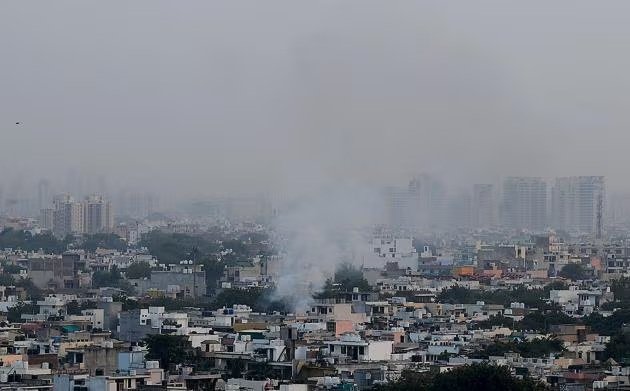
Gurugram (Balwinder Singh): Gurugram witnessed a sharp deterioration in air quality on Monday morning following Diwali celebrations, ranking as the second most polluted major city in India during the early hours. The city’s AQI climbed to approximately 307 between 7 am and 8 am, according to IQAir’s live pollution rankings, placing it in the very poor category.
Only Prayagraj recorded a higher reading, with an AQI of around 325. Asansol followed with 275, while Varanasi registered 255. Noida and Delhi both reported readings of approximately 250 during the same period, indicating that Gurugram’s air was more polluted than the national capital at that time.
The impact of post-Diwali pollution was also evident at Gurugram’s Vikas Sadan monitoring station. At around 7:30 am, the Haryana State Pollution Control Board station recorded a PM2.5 concentration of 105.9 micrograms per cubic metre, corresponding to an AQI of approximately 252. A layer of smoky haze covered parts of the city as temperatures remained around 22 degrees Celsius.
The situation had already been concerning on Diwali day. According to the Central Pollution Control Board’s daily bulletin, Gurugram recorded an average AQI of 288 on Sunday, based on readings taken until 4 pm. PM2.5 was identified as the dominant pollutant.
Neighbouring Faridabad also reported elevated pollution, with its AQI reaching 291. Both PM2.5 and PM10 contributed significantly to the city’s poor air quality, bringing the reading close to the 300-point threshold for the very poor category.
Other National Capital Region (NCR) cities were facing similar conditions. Delhi recorded an AQI of 376, while Ghaziabad stood at 344 and Noida registered 318. Ballabgarh in Faridabad district reported an even higher reading of 398, approaching the severe pollution category.
The rising pollution levels have raised concerns over the health of residents, particularly those living with respiratory and cardiovascular conditions. The CPCB warns that prolonged exposure to poor air quality can cause breathing discomfort among most people, with individuals suffering from asthma and heart or lung diseases facing greater risks.
The post-festival pollution spike has once again highlighted the air quality challenges confronting Gurugram and other NCR cities, where firecracker emissions have added to the existing pollution burden.
