

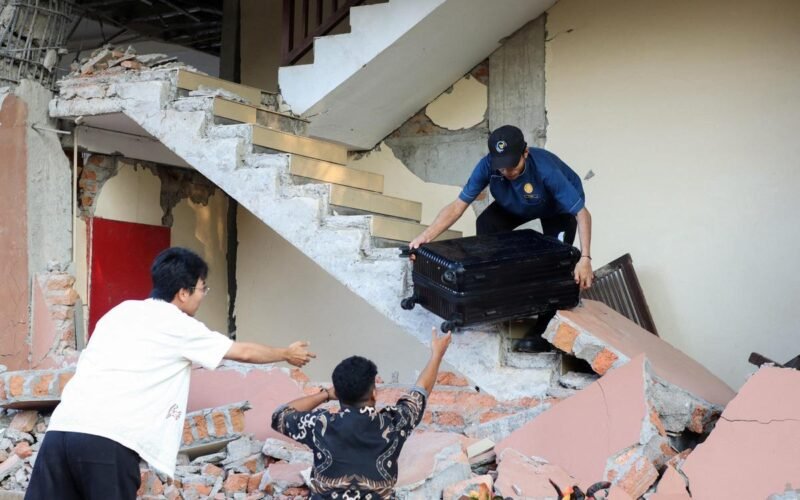
Flores (Rajeev Sharma): Rescue workers in Indonesia’s Flores island continued digging through collapsed homes and landslide debris on Sunday as authorities raced to locate survivors following a powerful earthquake that has killed at least 47 people and injured more than 100.
The earthquake struck eastern Indonesia on Saturday, causing widespread structural damage and triggering landslides in several parts of Flores. Thousands of residents have been moved to safer locations as emergency crews work amid damaged roads, unstable ground and interruptions to electricity and communication services.
Manggarai and East Manggarai among worst-hit areas
Indonesia’s National Disaster Management Agency reported that Manggarai recorded 24 deaths, while 17 fatalities were reported in East Manggarai. Further casualties were recorded in Sikka, Ngada and Ende.
Rescuers have been focusing on collapsed buildings and areas covered by landslides, where officials fear additional victims could still be trapped beneath the debris.
The United States Geological Survey measured the earthquake at magnitude 7.7. It said the epicentre was located around 68 kilometres north-northwest of Ende in East Nusa Tenggara province, at an offshore depth of approximately 10 kilometres.
Thousands seek shelter after homes damaged
The strong tremor destroyed more than 900 houses and damaged hundreds of others, leaving thousands of people without safe accommodation.
Officials estimate that roughly 5,000 residents have been relocated to temporary shelters. Others have opted to stay outside their homes, worried that further tremors could bring down already weakened structures.
Damage was also reported at around 167 public facilities, including schools, healthcare centres and churches.
Relief agencies have begun supplying affected communities with basic necessities such as drinking water, rice, prepared food, blankets and medicines. Temporary accommodation is being arranged for families whose homes were destroyed or declared unsafe.
Landslides create major challenge for rescuers
The mountainous terrain of Flores has made the rescue effort particularly difficult. Landslides triggered by the earthquake blocked portions of the Trans-Flores Highway, cutting off road access to several communities.
Workers have been removing rocks, soil and other debris in an effort to restore links with isolated villages. Emergency authorities are also working to bring electricity and communication networks back online.
Some roads leading to previously inaccessible areas have now been reopened, allowing rescue and relief teams to reach more residents.
Search continues in hard-to-reach locations
Search teams resumed operations in parts of Manggarai, East Manggarai and Nagekeo after initially being hampered by damaged infrastructure.
Crews are checking destroyed houses and other structures while examining landslide sites for signs of people who could have been buried.
Authorities have continued to warn residents to remain cautious as unstable structures and possible aftershocks pose additional risks.
Strong tremors felt in Labuan Bajo
The earthquake was also felt in Labuan Bajo, a major tourist centre and gateway to Komodo National Park. Landslides in the wider area affected road connections, adding to concerns among residents and visitors.
Many people remained outdoors overnight rather than returning to damaged buildings, fearing further seismic activity.
Indonesia is particularly exposed to earthquakes because it lies along the Pacific Ring of Fire, an area where several tectonic plates interact and where seismic and volcanic activity is common.
Flores has experienced deadly earthquakes before. A powerful earthquake and tsunami in 1992 caused widespread devastation on the island and killed around 2,500 people.
For now, emergency crews remain focused on the search for survivors, clearing blocked roads and delivering essential supplies. Officials are continuing to assess the damage as rescue operations move into more remote parts of the island.
