

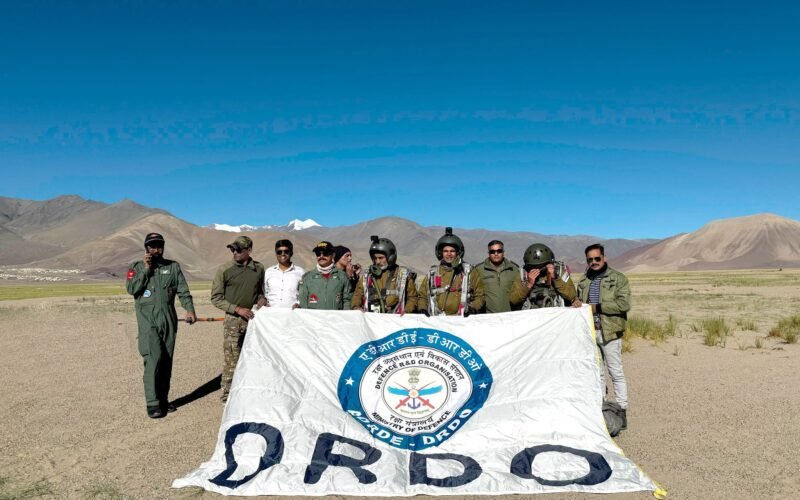
New Delhi (Rajeev Sharma): In a significant demonstration of indigenous defence technology, the Defence Research and Development Organisation (DRDO) has successfully tested its Military Combat Parachute System (MCPS) at an altitude of 22,000 feet above mean sea level.
The trial was conducted at the Nyoma-Mudh Drop Zone in Ladakh, regarded among the highest-altitude drop zones in the world. The test was designed to assess the performance of the combat parachute system in the kind of severe conditions encountered during high-altitude airborne operations.
The MCPS has been developed by the Aerial Delivery Research and Development Establishment (ADRDE), a DRDO laboratory specialising in aerial delivery systems.
Test Conducted at Minus 15°C
The high-altitude jump was carried out by ADRDE’s test jumpers — Wing Commander Rahul Jha, Chief Test Jumper, Master Warrant Officer R J Singh, VM(G), and Master Warrant Officer Vivek Tiwari.
The team exited the aircraft at approximately 22,000 feet, where the ambient temperature was around minus 15°C. Along with the MCPS, the jumpers used the system’s supporting indigenous equipment, including a para computer, oxygen system and specialised jumpsuits.
The main parachute was deployed at approximately 20,000 feet. The jumpers subsequently completed the descent and landed safely at around 13,700 feet.
Indigenous Subsystems Tested Together
The trial went beyond testing the parachute alone. The associated equipment was also employed during the jump, allowing the system to be assessed as an integrated package in an extreme operating environment.
The successful demonstration showed that the MCPS and its supporting systems could function under challenging conditions involving very low temperatures and high-altitude atmospheric conditions.
According to the DRDO, the exercise demonstrated the system’s efficacy, reliability and tactical employability for high-altitude military operations.
Push for Self-Reliant Defence Technology
The achievement adds to India’s efforts to develop critical military technologies domestically under the broader objective of defence self-reliance.
An indigenous combat parachute system can provide the armed forces with greater control over a specialised capability used in airborne operations, while reducing dependence on overseas technologies.
The successful test at Nyoma-Mudh is also significant because equipment intended for high-altitude deployment must perform reliably in an environment marked by extreme cold, thin air and demanding operational conditions.
The latest demonstration is expected to support further evaluation and development of the MCPS, strengthening India’s indigenous capability in advanced aerial delivery and airborne military systems.
