

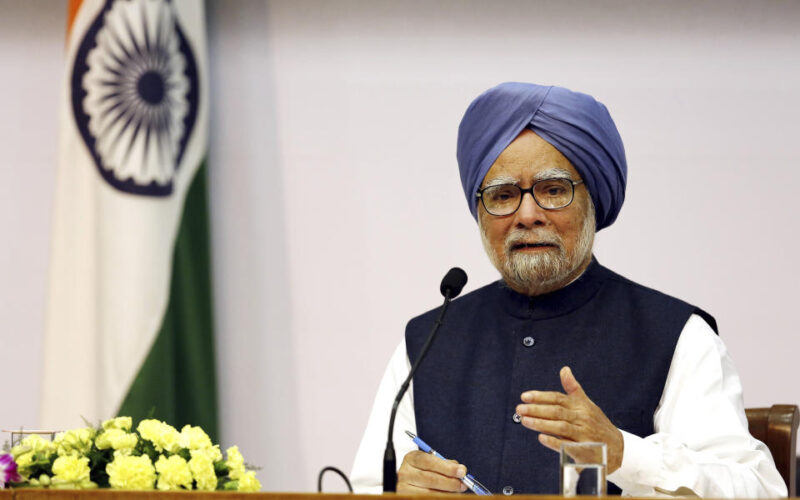
Hyderabad (Rajeev Sharma): Calls to confer the Bharat Ratna posthumously on former Prime Minister Manmohan Singh gained renewed momentum on his 94th birth anniversary, with Telangana Chief Minister A. Revanth Reddy making a fresh appeal for the country’s highest civilian honour to be awarded to the late statesman.
Reddy made the demand while unveiling a statue and memorial dedicated to Singh in Hyderabad. He described the former prime minister as a towering statesman whose contribution to India would remain part of the country’s history for generations.
The Telangana chief minister also pointed to Singh’s role in the economic transformation that began in 1991. As finance minister under Prime Minister P.V. Narasimha Rao, Singh played a central role in introducing sweeping economic changes at a time when India was facing a serious financial crisis. The reforms reduced several government controls, opened the economy to greater private participation and laid the groundwork for a period of faster economic growth.
For Singh’s admirers, however, his claim to national recognition goes beyond the economic reforms of 1991.
His career combined academic distinction, administrative experience and political leadership. From teaching economics to holding senior government positions, Singh spent decades working at the intersection of scholarship and public policy before becoming prime minister in 2004.
His personal journey has also become an important part of the legacy being remembered after his death.
Born in Gah, in present-day Pakistan, Singh grew up in modest circumstances. Accounts of his childhood describe a family living without basic amenities such as electricity and running water. His early education took place in a small village school before he moved to his uncle’s home to continue his studies.
From those beginnings, Singh went on to establish an extraordinary academic career. He studied at Panjab University before pursuing higher education at Cambridge and Oxford. His reputation as an economist eventually took him into the highest levels of India’s economic administration.
Former Planning Commission deputy chairman Montek Singh Ahluwalia has often spoken about Singh’s intellectual abilities and his relatively humble upbringing. Recalling Singh’s early years, Ahluwalia has noted that even those who worked closely with him sometimes knew little about the hardships he experienced as a child.
Singh’s academic achievements were particularly striking when viewed alongside those of other prominent South Asian economists of his generation. His contemporaries included Amartya Sen and Jagdish Bhagwati, and Singh was among the Indian students at Cambridge who received the prestigious Adam Smith Prize.
His influence on economic policy may also have begun much earlier than the landmark reforms of 1991.
According to accounts recalled by Ahluwalia, Singh had advocated greater trade liberalisation and fewer restrictions on private enterprise soon after joining the government in the early 1970s. The proposal came at a time when India’s economic policy remained heavily influenced by state controls.
The reforms that Singh would later oversee as finance minister therefore represented a culmination of ideas that had occupied him for years.
His career in government began with senior economic positions, including Economic Adviser and Chief Economic Adviser. He later served as Governor of the Reserve Bank of India and held other important responsibilities before entering electoral politics.
As prime minister, Singh led the United Progressive Alliance government for two consecutive terms from 2004 to 2014. His tenure included the expansion of welfare programmes, rapid economic growth during several years and the controversial negotiations over the Indo-US civil nuclear agreement.
Supporters of the Bharat Ratna demand have also highlighted Singh’s conduct during the nuclear agreement controversy. They argue that his decision to persist with the agreement, despite the political difficulties it created for his government, reflected his commitment to what he believed was in the country’s long-term interest.
Former Union law minister Ashwani Kumar has described Singh as a person whose public service, scholarship and personal integrity made him worthy of the nation’s highest civilian recognition.
Singh’s supporters also emphasise another aspect of his public life: his understated personality. Unlike many political figures, he rarely sought the spotlight and generally allowed his work and positions to speak for him.
The question of awarding him the Bharat Ratna has consequently become part of the wider debate over how his legacy should be remembered.
The Telangana Assembly had earlier passed a resolution seeking the honour for Singh, and the latest appeal from the state government has brought the issue back into public discussion.
For his admirers, Singh’s journey—from a modest childhood in undivided India to the country’s highest political office—forms an important part of the case for recognising his contribution. His supporters point not only to the 1991 reforms but also to decades of academic work, public administration and political leadership.
Whether the Centre eventually decides to confer the Bharat Ratna on him remains a matter for the government. What is clear is that Manmohan Singh’s legacy continues to be closely associated with India’s economic transformation, his scholarly achievements and a style of public life marked by restraint and humility.
