

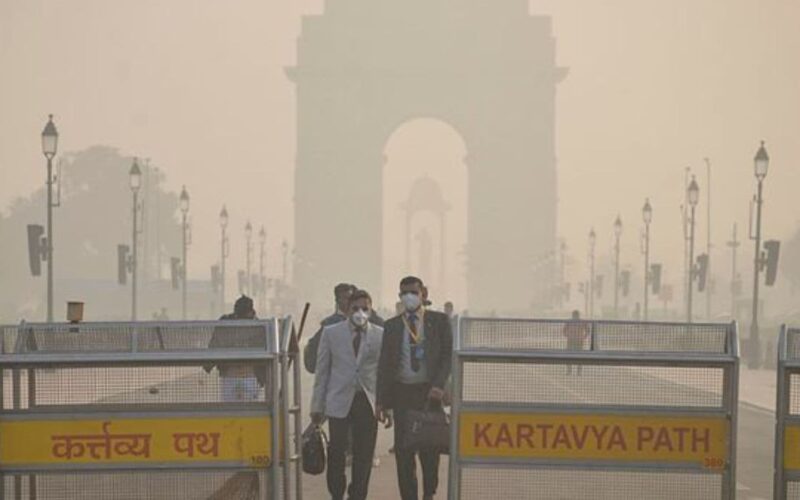
Delhi (Rajeev Sharma): Delhi woke up to a thick blanket of smog on Diwali morning, with the capital’s overall Air Quality Index (AQI) reaching 483 at 8:10 am on Sunday. The reading placed the city’s air quality firmly in the severe category, with several monitoring stations reporting pollution levels above the 400 mark, according to the Central Pollution Control Board (CPCB).
The deterioration was particularly evident across several residential and commercial areas. Punjabi Bagh recorded an AQI of 449, while RK Puram stood at 448. Bawana registered 446, with IIT Delhi and Rohini reporting 445 each. Chandni Chowk recorded 420, Patparganj 421 and Alipur 413.
Other locations remained in the very poor category. Narela reported an AQI of 395, while Anand Vihar registered 328. The air quality near India Gate stood at 398, and the Akshardham Temple area recorded 336.
The latest figures represent a considerable decline from Saturday morning, when Delhi’s overall AQI was 364 at 8 am. Reduced visibility and a dense layer of haze across several neighbourhoods added to concerns over the worsening pollution situation.
GRAP Stage III restrictions already in place
The pollution spike comes after the Commission for Air Quality Management (CAQM) activated Stage III of the Graded Response Action Plan (GRAP) across Delhi-NCR on Friday. The decision was taken in anticipation of deteriorating air quality around the Diwali period.
Under the emergency framework, existing pollution-control restrictions remain operational, with additional measures and stricter monitoring directed at agencies responsible for controlling emissions. The measures cover Delhi and adjoining districts of Haryana, Uttar Pradesh and Rajasthan.
GRAP is implemented in four stages, with restrictions becoming increasingly stringent as pollution levels rise. Authorities use forecasts from the India Meteorological Department (IMD) and the Indian Institute of Tropical Meteorology (IITM) to initiate preventive action before air quality reaches critical levels.
Understanding Delhi’s AQI readings
Under CPCB standards, AQI readings from 0 to 50 are classified as good, 51–100 as satisfactory, 101–200 as moderate, 201–300 as poor, 301–400 as very poor and 401–500 as severe.
With the capital recording 483 on Sunday morning, the latest figures highlight the serious pollution challenge facing residents as winter conditions begin to settle over the region.
