

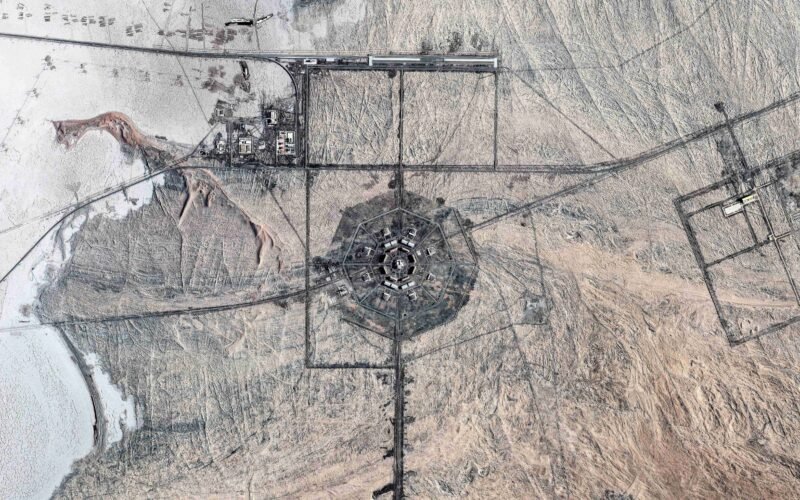
Beijing (Rajeev Sharma): A massive military construction programme unfolding deep inside China’s northwestern desert is attracting growing attention from nuclear experts, with newly identified structures raising questions about how Beijing plans to manage and protect its rapidly expanding strategic arsenal.
Satellite imagery reviewed by independent analysts has revealed an intricate network of octagon-shaped facilities, communication installations and support infrastructure positioned near China’s missile silo fields in Xinjiang. While officials have offered no public explanation for the developments, specialists believe the project could significantly enhance the country’s nuclear command and operational capabilities.
The scale of construction has surprised even veteran observers who monitor global nuclear forces.
More Than Just Missile Silos
In recent years, international researchers have documented the rapid growth of China’s intercontinental ballistic missile programme, including the construction of hundreds of new silos across remote desert regions. However, analysts say the latest discoveries suggest Beijing’s efforts extend far beyond simply deploying missiles.
The newly observed facilities appear to form a broader support ecosystem surrounding the silo fields. Networks of underground conduits connect launch areas to large octagonal compounds, indicating the possibility of dedicated communications, maintenance or command facilities operating alongside the missile infrastructure.
Experts studying the imagery say the purpose of the connections remains uncertain, but secure communications systems are considered one of the most likely explanations.
The extensive layout has led some analysts to conclude that the facilities may be designed to ensure continuity of operations during wartime or in the event of a strategic attack.
Communication Towers Add to the Mystery
Particular interest has centred on one northern installation where construction crews appear to be building large towers and satellite communication facilities.
The structures have prompted speculation that the site could serve as a key communications hub supporting China’s strategic forces. Secure command-and-control systems are considered essential for any nuclear power, allowing military leaders to transmit instructions and maintain contact with deployed assets under all circumstances.
Several analysts believe the combination of satellite dishes, communications towers and interconnected support facilities points toward a broader operational role rather than simple storage or maintenance functions.
Although no definitive conclusions have been reached, the developments have reinforced perceptions that China is investing heavily in modernising every aspect of its nuclear deterrent.
Separate Facility Appears Linked to Military Training
A third octagonal complex located near the historic Lop Nur testing region presents a different picture.
Unlike the more sophisticated sites near the missile fields, this installation appears to function as a training or weapons-testing area. Satellite photographs show damaged buildings, cratered terrain and structures believed to simulate military targets.
Imagery experts have identified objects resembling combat aircraft mock-ups, potentially providing Chinese forces with realistic targets for testing precision-guided weapons and operational tactics.
The presence of such facilities highlights the diverse nature of the broader military development programme underway across the region.
Different Approach From Other Nuclear Powers
The emerging infrastructure also appears to reflect a strategic philosophy that differs from those traditionally adopted by the world’s largest nuclear powers.
The United States and Russia have historically relied on vast numbers of missile silos, hardened underground facilities and geographic separation to ensure the survivability of their nuclear forces. China’s latest developments suggest it may be placing greater emphasis on integrated support networks, communications systems and localised defensive measures around key strategic assets.
Military analysts say this could be part of an effort to create a more resilient and responsive nuclear force capable of operating under increasingly complex security conditions.
Expansion Reflects Broader Strategic Ambitions
The construction activity comes amid a period of significant military modernisation in China. Over the past decade, Beijing has invested heavily in advanced missile systems, naval capabilities, aerospace technologies and strategic deterrence infrastructure.
Western governments and defence experts have repeatedly pointed to the rapid growth of China’s nuclear arsenal as one of the most consequential developments in global security.
The newly identified facilities add another dimension to that transformation, suggesting that China is not only increasing the size of its arsenal but also investing in the infrastructure required to sustain and protect it over the long term.
An Unprecedented Project
For analysts who track military infrastructure around the world, the scale of the desert construction programme remains remarkable.
The combination of missile fields, communications facilities, support compounds and defensive installations spread across vast stretches of remote terrain has few modern comparisons. While many questions about the facilities remain unanswered, experts agree that the project represents one of the most ambitious strategic military undertakings currently visible anywhere in the world.
As construction continues and additional imagery becomes available, the developments are likely to remain a focal point for governments, intelligence agencies and arms-control researchers seeking to understand the future direction of China’s nuclear strategy.
