

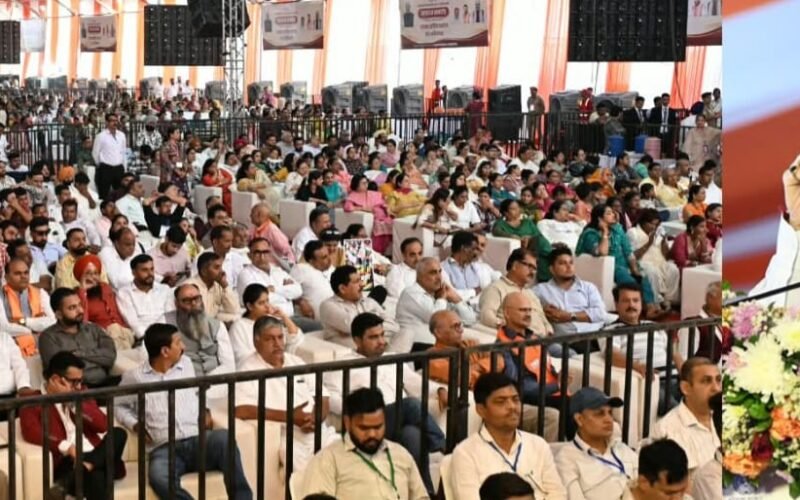
Chandigarh (Balwinder Singh) — Union Home and Cooperation Minister Amit Shah officially dedicated the historic 1857 First War of Independence Memorial to the nation in Ambala on Thursday, paying homage to the valour, sacrifices, and enduring legacy of India’s early freedom fighters. Joined by Haryana Chief Minister Nayab Singh Saini, Union Power Minister Manohar Lal, and Transport Minister Anil Vij, the ceremony marked the opening of one of the country’s most ambitious historical monuments, designed to educate and inspire future generations about the inception of the national liberation movement. As part of the proceedings, dignitaries participated in the “Ek Ped Maa Ke Naam” campaign by planting saplings across the grounds before lighting the ceremonial lamp and viewing an introductory virtual reality showcase chronicling Haryana’s pivotal role in the rebellion.
Spanning 22 acres, the massive complex centres on a three-storey museum housing 22 meticulously curated galleries that merge classic heritage with state-of-the-art interactive installations. Moving well beyond standard static exhibits, the narrative takes visitors through a chronological journey starting with the arrival of British colonial forces and the systemic disruption of indigenous life, illustrated through traditional Haryanvi Phulkari embroidery. The exhibits examine the tactical dimensions of the uprising, displaying how indigenous Sarkanda craftwork, the clandestine circulation of chapatis, and the exchange of lotus blooms were deployed alongside harsh summer weather conditions to organise coordinated resistance against colonial rule.
A central narrative highlight rests on Ambala’s strategic geography and documented timeline, which details how open unrest and mysterious fires erupted in the cantonment weeks before the rebellion spread elsewhere. Historical records and interactive telegraph installations recreate the precise moment on the morning of May 10, 1857, when the 60th and 5th Native Infantries launched their revolt in Ambala, preceding the uprising in Meerut by roughly nine hours. Advanced projection mapping, augmented reality dioramas, and traditional wooden carvings vividly recount the fierce battles waged across Haryana’s towns and rural settlements by local monarchs, farmers, and soldiers.
The remaining galleries trace the nationwide ripple effects through full-scale reconstructions of flashpoints such as the Kashmiri Gate, Meerut Jail, and Jhansi Fort, alongside an evocative sand installation sculpted from soil collected at major revolutionary sites across the country. Darkened corridors replicate the severe conditions of colonial-era penal barracks, leading toward reflective memorials including the Sacrifice Gallery, where a solitary tree honours the countless individuals executed during the conflict. The chronological sequence culminates in a solemn tribute hall where visitors can pause to honour the memory of both prominent leaders and unsung martyrs.
Beyond its interior galleries, the complex integrates several major outdoor and public amenities, anchored by a 63-metre memorial tower featuring high-speed elevators, observation platforms, and interactive digital registries. The grounds also feature a 2,500-capacity open-air amphitheatre equipped with dual water screens and facade-projection mapping systems for nightly light-and-sound shows, alongside a 300-seat auditorium, dedicated research library, dual-level underground parking, and a helipad, establishing the landmark as an enduring centre of historical scholarship and national remembrance.
