

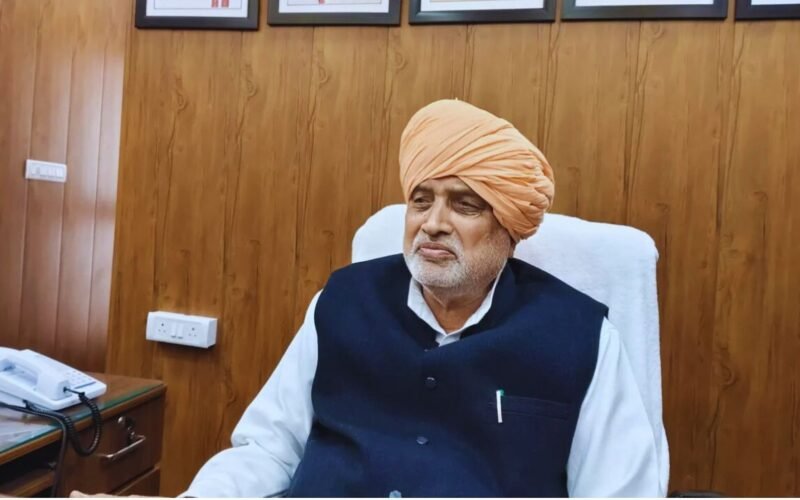
Chandigarh (Balwinder Singh)– Haryana Agriculture and Farmers’ Welfare Minister, Sh. Shyam Singh Rana, said that the “Haryana Cold Chain Policy” will serve as the foundation for integrating the collection, storage, transportation and marketing of agricultural produce in the State. The objective of the policy is not merely to establish cold storages, but to ensure that farmers’ produce reaches more profitable markets while maintaining better quality. It will focus on reducing post-harvest losses, increasing farmers’ income, encouraging private investment and promoting energy-efficient and environment-friendly technologies. He informed that the Chief Minister has approved this new policy.
Sh. Shyam Singh Rana said that under the “Haryana Cold Chain Policy”, the infrastructure required at the district level will be identified on the basis of local production and market demand. Integrated development of modern packhouses, collection centres, pre-cooling units, cold storages and refrigerated transportation facilities will be promoted in production clusters. Village-level packhouses will function as centres for collecting farmers’ produce, cleaning, sorting, grading and packaging it before dispatching it to markets. Special emphasis will also be laid on connecting these facilities with transportation networks and onward market linkages.
He said that a key objective of the policy is to provide relief to farmers from the compulsion of selling their produce immediately after harvesting, reduce their dependence on middlemen and provide them with more opportunities to access markets of their choice. Aggregation of produce through Farmer Producer Organisations (FPOs) and direct linkages with retail chains, processing units, exporters and e-commerce platforms will be encouraged. Special attention will also be given to the participation of women and disadvantaged sections of farmers.
The Agriculture and Farmers’ Welfare Minister further said that the scope of the policy is not limited to fruits and vegetables. It will cover major perishable and temperature-sensitive commodities from agriculture and allied sectors, including cereals, pulses, oilseeds, spices, milk, eggs, fish, meat and dry fruits.
*Horticulture Department to coordinate, concerned departments to implement the policy*
He said that the Horticulture Department will act as the nodal department and coordinate among various departments, ensure convergence of schemes, review progress and monitor outcomes. All activities will not be carried out solely by the Horticulture Department. The State Government will assign responsibilities to the concerned government departments, boards, corporations and institutions according to the nature of work, their respective domains and technical requirements.
The State-level monitoring mechanism will include representatives from Agriculture and Farmers’ Welfare, Animal Husbandry and Dairying, Fisheries, Cooperation, and New and Renewable Energy sectors, along with the Haryana State Agricultural Marketing Board, NABARD and research institutions. Under the policy, the Marketing Board will play a role in developing market yard, collection and transportation-related facilities, while HAREDA may support the promotion of renewable energy and energy-efficient cold chain systems. Technical institutions, Krishi Vigyan Kendras and universities will also be associated to provide technical guidance, capacity building and improve the operational efficiency of projects.
*Market prices and transportation information to help farmers make informed decisions*
He said that provisions have been made for displaying daily market prices and information about the availability of transportation facilities at packhouses so that farmers can make better decisions regarding harvesting and selling their produce. The development of digital platforms connecting farmers, buyers and cold chain transportation service providers will also be encouraged. Facilities such as tracking the movement of produce dispatched to markets and tracing its source will help enhance transparency in the supply chain.
*Modernisation of existing cold storages and energy conservation to be prioritised*
Sh. Rana further said that the policy will promote the modernisation of existing cold storages, upgradation of old refrigeration systems, use of solar and other renewable energy sources, and adoption of environment-friendly technologies. Emphasis will also be laid on energy audits, digital temperature monitoring and transportation tracking systems. Performance standards will be developed to assess the operational efficiency of cold chain facilities, energy consumption, product losses and service quality. The ratings awarded on the basis of these standards will be linked to incentives and modernisation assistance.
*Policy to be implemented in three phases; success to be measured by benefits to farmers*
The Agriculture and Farmers’ Welfare Minister further informed that the “Haryana Cold Chain Policy” will be implemented in three phases: 2026–2032, 2033–2040 and 2041–2047. The first phase will focus on performance standards, energy audits, training, digital connectivity, modernisation of existing facilities and priority production clusters. The subsequent phases will emphasise expansion of the cold chain network, increased use of renewable energy and stronger linkages with high-value and export markets.
