

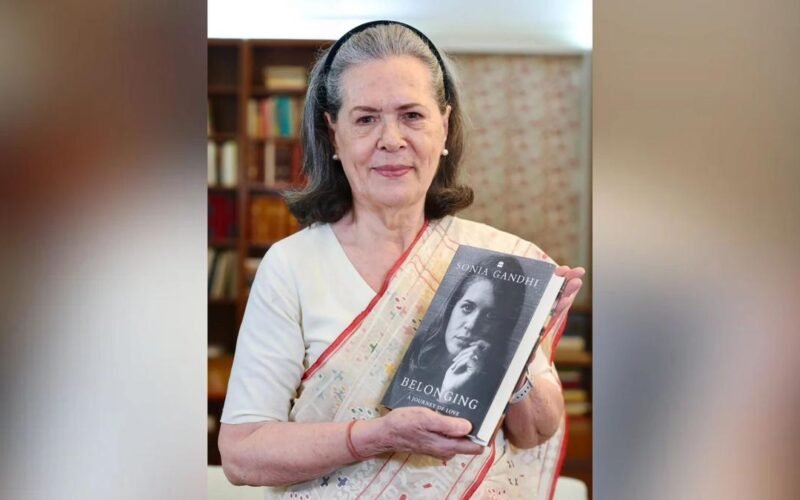
New Delhi (Rajeev Sharma): With Punjab’s political landscape drawing renewed attention ahead of the Assembly elections, Sonia Gandhi’s book Belonging: A Journey of Love has brought the events leading up to Operation Blue Star back into focus. In its 16th chapter, she offers her account of the intelligence inputs received by then Prime Minister Indira Gandhi and the circumstances surrounding the Army operation at the Golden Temple in June 1984.
According to Sonia Gandhi’s account, Jarnail Singh Bhindranwale and his supporters had allegedly been working towards establishing an independent Khalistan since 1982. She writes that August 15, 1984, had been identified as the date for formally announcing the proposed state and raising its flag at Harmandir Sahib in Amritsar.
The book claims that intelligence agencies alerted Indira Gandhi to the plan, prompting her government to launch Operation Blue Star. The military action began on June 1, 1984, while the Army entered the Golden Temple complex on June 4. Sonia acknowledges the extensive damage suffered by the revered Sikh shrine and says the development caused deep anguish. She also recalls that Indira Gandhi was distressed after seeing photographs of the operation.
How Bhindranwale established his influence
Looking back at the political developments in Punjab, Sonia Gandhi traces the background to the Akali Dal’s movements for the reorganisation of states on linguistic lines after Independence. Punjab was reorganised in 1966 under Indira Gandhi, leading to the creation of Haryana and the separation of Himachal Pradesh. However, disputes over several other demands continued, providing the backdrop to Bhindranwale’s emergence.
The book describes his movement as a violent separatist campaign aimed at deepening divisions between Hindus and Sikhs. It also alleges that Pakistan’s intelligence agencies had infiltrated the movement and sought to destabilise Punjab through violence. Bombings, killings and bus hijackings are cited as part of the unrest during that period.
Golden Temple complex turned into an armed base
Sonia writes that Bhindranwale moved his base into the Golden Temple complex in 1982 and gradually developed an alternative system of authority. According to the account, disputes were settled through a parallel judicial arrangement, while orders and hit lists were issued from within the premises.
The book further claims that weapons, including pistols, Kalashnikov rifles and mortars, were stockpiled inside the complex. It alleges that people from both Sikh and Hindu communities who opposed Bhindranwale’s political objectives were targeted by his supporters.
Security concerns after Operation Blue Star
Sonia Gandhi also recounts the consequences of the operation for the Gandhi family. She writes that the threat to Indira Gandhi’s life became more serious in its aftermath.
Recalling a conversation with Indira Gandhi, Sonia says the former intelligence chief M.K. Kao had warned of a possible threat involving the abduction of Rahul and Priyanka. The children were subsequently brought back from their boarding schools and admitted to schools in Delhi, disrupting their education but allowing them to remain close to their grandmother during the final two months of her life.
Through the chapter, Sonia presents Operation Blue Star as a decision taken by Indira Gandhi in response to what she describes as a threat to India’s territorial integrity, while also acknowledging the lasting pain caused by the damage to one of Sikhism’s most sacred sites.
