

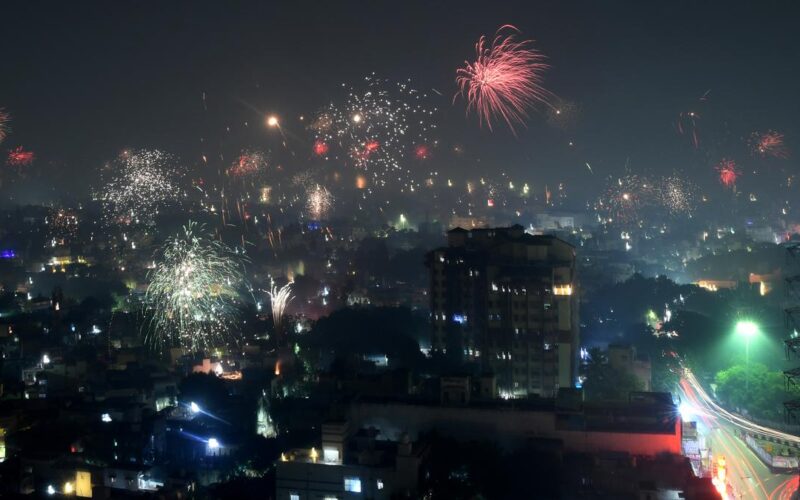
New Delhi (Rajeev Sharma): Air pollution levels in the national capital have witnessed a significant spike, with a thick blanket of smog covering several parts of the city on Friday. Delhi’s overall Air Quality Index (AQI) reached 391 by 9 am, bringing it dangerously close to the severe category just two days before Diwali.
Data from 59 air quality monitoring stations revealed that 30 locations had already entered the severe pollution category by Friday morning, while the remaining stations reported very poor air quality.
Rohini emerged as the worst-affected area, recording an AQI of 475, while the monitoring station at IIT-Delhi registered 472, highlighting the worsening pollution situation across the capital.
The Air Quality Early Warning System has indicated that Delhi could experience its first severe pollution day of the current season on Friday. The forecast suggests that unhealthy conditions may continue through November 8, coinciding with Diwali celebrations.
The deteriorating air quality has raised concerns as the National Capital Region is currently witnessing the peak period of agricultural stubble burning. Additional emissions from firecrackers during the festive celebrations could further increase the concentration of pollutants in the atmosphere.
The city’s AQI stood at 389 at 8 am before climbing to 391 an hour later. Under the Central Pollution Control Board’s classification, readings between 301 and 400 fall under the very poor category, while levels from 401 to 500 are considered severe.
Weather experts have warned that pollution levels at several hotspots could cross the 450 mark, particularly if emissions from crop residue burning and Diwali fireworks intensify.
Meanwhile, weather conditions have also remained relatively warm for this time of the year. The minimum temperature at Safdarjung, Delhi’s base weather station, was recorded at 17.2 degrees Celsius, which is 1.9 degrees above the seasonal average.
The India Meteorological Department has predicted a maximum temperature of approximately 30 degrees Celsius on Friday. Shallow fog is also expected during the morning hours, with similar conditions likely to continue in the capital until November 9.
With Diwali approaching, the latest pollution readings have renewed concerns over the capital’s deteriorating air quality and the possibility of a further increase in pollution levels over the coming days.
