

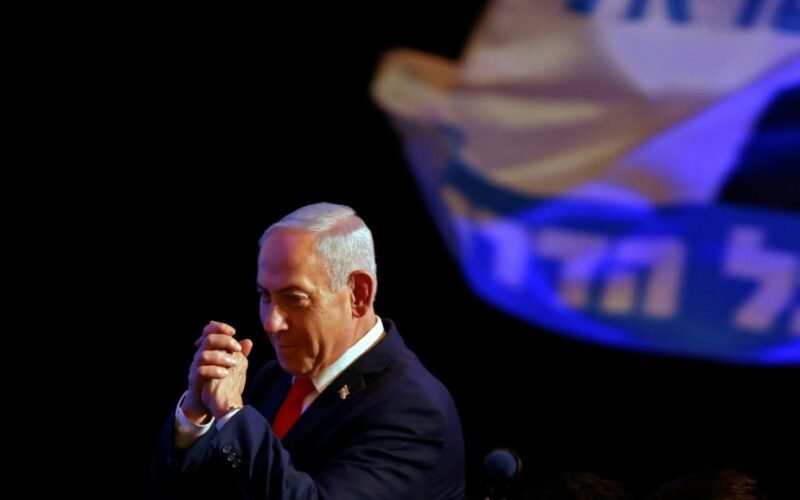
JERUSALEM (Rajeev Sharma): Israeli Prime Minister Benjamin Netanyahu’s political allies were ahead in the latest partial election results, securing 53 seats against 48 for the opposing Jewish-led bloc, as around 90 per cent of votes had been counted, according to figures reported by The Times of Israel.
The preliminary figures, released by the Central Elections Committee at 11.35 pm local time, were based on the count from 97.5 per cent of ballot boxes. Despite the lead for Netanyahu’s camp, the results indicated that neither side had secured a clear path to forming a government, leaving coalition negotiations likely to play a decisive role.
Israel’s parliament, the Knesset, has 120 seats, meaning a governing coalition generally requires the support of at least 61 lawmakers.
Opposition Faces Challenge Despite Netanyahu Bloc’s Lead
The emerging seat distribution presents a complicated picture for Netanyahu’s opponents. While the pro-Netanyahu parties were projected to hold 53 seats, the opposing Jewish-led parties had 48. Arab-led parties accounted for another 19 seats, bringing the combined strength of parties outside Netanyahu’s bloc to 67.
However, the opposition’s numerical advantage does not automatically translate into a viable parliamentary majority. Divisions among the parties, particularly the reluctance of several Jewish-led factions to cooperate with Arab-led groups, could complicate efforts to assemble a coalition.
The final distribution of seats could also shift as the remaining ballots are processed.
Gadi Eisenkot Vows to Continue Efforts for Political Change
Yashar chairman Gadi Eisenkot, a prominent opposition figure, described the emerging outcome as a rejection of Netanyahu’s government.
In a post on X, Eisenkot criticised the administration over its handling of the aftermath of the October 7 attacks and the contentious issue of military conscription. He argued that voters had expressed a lack of confidence in the government and its allies.
Despite the opposition bloc’s difficulties in securing a workable majority, Eisenkot said he would continue pursuing political change.
He also stressed that further work lay ahead, pledging to focus on forming a government committed to change and military service requirements.
Uncertainty Persists as Remaining Ballots Are Counted
Election officials cautioned that the published figures were provisional and could change as the counting process continued.
One important factor is the processing of double-envelope ballots, which include votes cast by active-duty military personnel. These ballots are generally counted during the later stages of the election process, meaning the final parliamentary composition may differ from the current projections.
Several smaller parties also remained below Israel’s 3.25 per cent electoral threshold, which determines whether a party qualifies for representation in the Knesset.
Among those listed in the partial returns were the Reservists, at 2.6 per cent; the People of Israel, at 1.6 per cent; and the Charedi Public faction, at 0.2 per cent. Their final vote shares could influence the overall allocation of seats if the results change sufficiently.
Yair Golan Begins Exploring Coalition Options
Meanwhile, Yair Golan, leader of the left-wing Democrats party, indicated that discussions over a possible government were already on his agenda.
In his first media appearance after polling stations closed, Golan announced plans to meet three party leaders as part of consultations on government formation. He did not disclose their identities.
The talks reflect the challenge facing Israel’s political opposition: even if parties collectively hold enough seats to challenge Netanyahu’s camp, they must still overcome ideological differences and disagreements over potential partnerships.
With the count incomplete and coalition alignments unresolved, the election remained politically unsettled. The final results, together with the willingness of rival factions to cooperate, will determine whether Netanyahu’s allies can assemble a governing majority or whether the opposition can find a viable alternative.
