

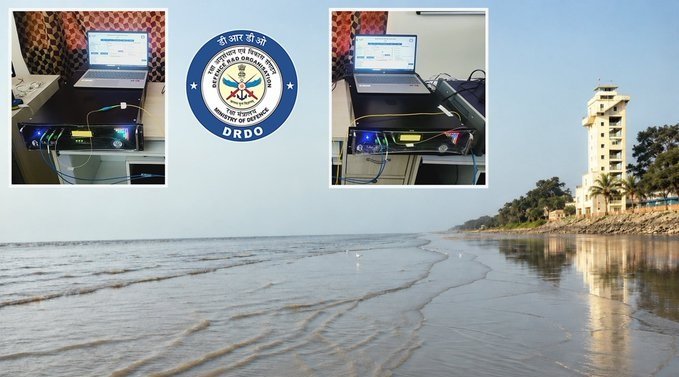
New Delhi (Rajeev Sharma): India has taken another step towards strengthening the security of its defence communications, with the Defence Research and Development Organisation (DRDO) successfully configuring and testing a Quantum Key Distribution (QKD) system on a live network used at its test ranges in Chandipur, Odisha.
In an announcement on social media, DRDO said the platform was tested at the Proof & Experimental Establishment (PXE), where artillery and armoured weapon systems undergo trials and evaluation. The technology is intended to protect sensitive information, including real-time observations and telemetry generated during weapons testing.
The successful demonstration highlights the potential application of quantum-based encryption in defence environments, where the secure transmission of operational data is essential.
Quantum technology to strengthen data protection
Quantum Key Distribution is a communication technique that uses principles of quantum physics to establish secure encryption keys between authorised parties. One of its key advantages is the ability to detect attempts to intercept the key exchange, allowing users to identify potential eavesdropping.
According to DRDO, the system has been designed to provide a high level of communication security, along with mechanisms to detect interception attempts. The technology could help safeguard critical data transmitted during the testing of artillery and armoured platforms.
Unlike conventional encryption methods, which rely primarily on mathematical techniques, QKD uses quantum properties to help identify interference during key distribution. However, the overall security of a deployed system also depends on its hardware, implementation and associated communication infrastructure.
Indigenous development with industry participation
DRDO said the QKD platform was developed under its Microelectronic Devices, Computational Systems and Cyber Security (MCC) cluster, with Taqbit Labs serving as the production partner.
The collaboration reflects efforts to develop advanced security technologies within India’s domestic defence research and industrial ecosystem.
Testing the platform on a live network at PXE provides a practical demonstration of its potential use beyond laboratory conditions. Protecting telemetry and observation data is particularly important during weapons trials, when information must be transmitted reliably without exposing sensitive technical details.
The latest development adds to India’s efforts to expand its capabilities in quantum technologies and strengthen cybersecurity across strategic sectors. Further information on the system’s performance, deployment plans and wider operational use has not yet been disclosed by DRDO.
