

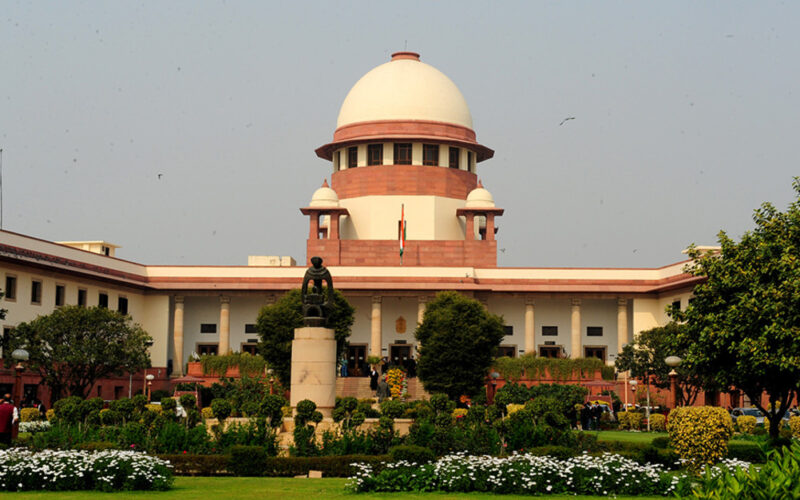
New Delhi (Gurpreet Singh): Supreme Court Justice Dipankar Datta on Wednesday rejected the oft-repeated description of India’s judicial appointment process as one where “judges appoint judges”, calling the phrase a “myth” and highlighting the role of the executive in the Collegium System.
Justice Datta made the observations while dealing with arguments concerning the mechanism for appointing members of the Election Commission. He rejected Solicitor General Tushar Mehta’s attempt to draw a parallel between the Collegium System and the selection mechanism for Election Commissioners.
“The oft-repeated phrase that ‘judges appoint judges’ is a myth,” Justice Datta said, adding that the narrative had been promoted through “motivated” accounts of the judicial appointment process.
Justice Datta Explains Executive’s Role In Collegium System
Justice Datta said the role of the Collegium is essentially recommendatory and that the executive remains involved at various stages before a judge is ultimately appointed.
He pointed out that the government is involved in the process of examining the credentials of candidates and that the final appointment is formally made by the President.
According to Justice Datta, recommendations made by the Collegium are not always implemented in full. He noted that there have been instances where one or more names from a list recommended for elevation were withheld by the executive.
“Acceptance of the recommendations is within the exclusive domain of the executive; it may, or may not, accept the recommendations. The final say rests with the executive,” he observed.
Supreme Court Judge Raises Concern Over Pending Recommendations
Justice Datta also questioned the selective implementation of recommendations made by the Collegium.
He said that on several occasions recommendations have not been acted upon by the executive without reasons being disclosed publicly. Some recommendations, he noted, have remained pending even after being reiterated.
The judge also referred to instances involving recommendations for the transfer of judges that were not acted upon.
Justice Datta said selective implementation could affect the sanctity of Collegium resolutions and raised a broader question over how long such a situation could continue.
How The Collegium System Works In India
The judicial appointment process is rooted in Articles 124 and 217 of the Constitution, which deal with the appointment of Supreme Court and High Court judges.
The present Collegium System evolved through three major Supreme Court judgments.
In the First Judges’ Case in 1981, the Supreme Court held that constitutional consultation did not necessarily mean concurrence, giving the executive greater primacy in judicial appointments.
The Second Judges’ Case in 1993 led to the creation of the Collegium System, comprising the Chief Justice of India and two senior-most Supreme Court judges for recommending appointments and transfers.
The Third Judges’ Case in 1998 expanded the Supreme Court Collegium to include the CJI and four senior-most judges.
NJAC Act Was Struck Down By Supreme Court
In 2014, Parliament passed the 99th Constitutional Amendment and the National Judicial Appointments Commission (NJAC) Act to replace the Collegium System.
However, a five-judge Constitution Bench of the Supreme Court struck down the constitutional amendment and the NJAC Act in 2015 by a 4:1 majority. The court held that judicial independence forms part of the basic structure of the Constitution.
Justice Datta, meanwhile, said criticism of the Collegium should also take into account the executive’s role in the appointment process.
He said that while the system could not guarantee that every appointment would be free from error, portraying the Collegium simply as a mechanism of “judges appointing judges” overlooked the broader constitutional and executive processes involved.
