

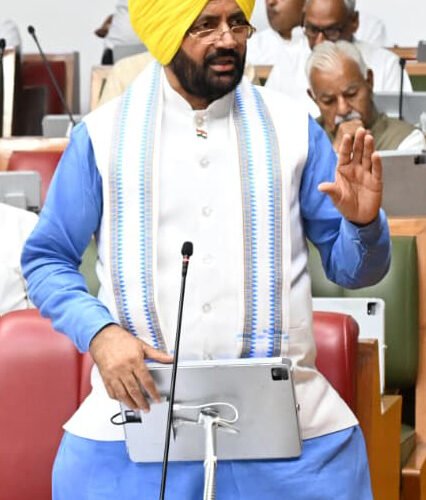
Chandigarh (Balwinder Singh) — Haryana Chief Minister Nayab Singh Saini mounted a robust defence of the Haryana Kaushal Rozgar Nigam Limited (HKRNL) in the state legislative assembly, presenting historical employment figures to counter opposition allegations regarding contractual recruitment. Speaking during a discussion on a calling attention motion, Saini stated that the establishment of HKRNL has dismantled decades of middleman exploitation, commission deductions, and recruitment opacity, replacing the old contractor system with a transparent, rule-bound, and employee-centric framework.
Addressing historical precedents, the Chief Minister noted that contractual and contingency-based staffing has existed in the state since its formation. Official records from March 1967 documented 11,397 contingency-paid and contractual workers out of a total government workforce of 97,385. Saini highlighted that while this combined category expanded by 27,552 personnel over the 38-year span between 1967 and 2005, the previous Congress administration added nearly 71,000 contractual workers in just nine years, pushing the total to roughly 110,000 by 2014 without instituting structural safeguards, standardized remuneration, or statutory protections.
Detailing the welfare measures introduced through HKRNL, Saini explained that standardized pay scales replaced arbitrary district-level rates starting in January 2022. Under the labour department rates revised in April 2026, monthly remuneration stands at 15,220.71 rupees for unskilled staff, 16,780.74 rupees for semi-skilled personnel, and 18,500.81 rupees for skilled workers, representing a 2.7-fold increase over the 2014 unskilled benchmark of 5,640 rupees. Furthermore, by levying only a 0.5 per cent operational fee instead of the conventional two per cent private contractor commission, the corporation has generated financial savings of approximately 78.56 crore rupees for the state exchequer.
The Chief Minister underscored that contractual engagement has been systematically integrated with statutory social security benefits, resulting in nearly 2,100 crore rupees deposited across Employee Provident Fund (EPF), Employees’ State Insurance (ESI), and Labour Welfare Fund accounts since the corporation’s inception. Additional institutional reforms include the approval of 1,316 Drawing and Disbursing Officer (DDO) shifting requests, compassionate employment provided to 306 eligible dependents, structured maternity leave, paid casual and medical leave allowances, and comprehensive medical coverage delivered through ESIC and the Chirayu healthcare programme.
