

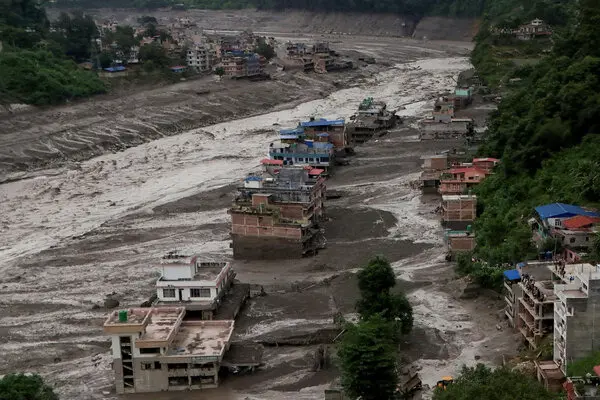
Kathmandu (Rajeev Sharma): Nepal is grappling with the aftermath of a devastating flash flood near the Tibet border, with the death toll rising to 469 and nearly 1,500 people still missing, including about 290 Indian nationals.
The disaster has affected several communities in the Himalayan region, leaving roads, bridges and other essential infrastructure damaged. Rescue personnel are continuing their efforts to locate people who remain unaccounted for, while authorities work to evacuate those stranded in remote areas.
Of the 469 reported deaths, three fatalities were recorded on the Tibetan side of the border.
Rescue Teams Reach Hundreds
Nepal Police said rescue operations have so far helped evacuate large numbers of people from the affected region.
As many as 796 people, including 50 foreign nationals, were airlifted to safety, while another 796 were evacuated through land routes.
Despite these efforts, the search remains challenging because several roads and access routes have been damaged by floodwaters and landslides. Rescue personnel are continuing to move into areas where communication and transport links have been disrupted.
Satellite Images Reveal Possible Trigger
Fresh analysis of satellite imagery has provided scientists with important clues about what may have triggered the disaster.
Geomorphologists Kristen Cook and Dan Shugar observed signs suggesting that the ground beneath a glacier collapsed. The failure appears to have brought a substantial mass of ice down the slope, carrying rocks and other debris into the valley.
The sudden movement of ice and rock could have generated the powerful flow that subsequently devastated areas downstream.
Scientists, however, have cautioned that the investigation is still at an early stage and the exact sequence of events has yet to be conclusively established.
Climate Change Raises Himalayan Flood Risks
The disaster has also revived concerns about the increasing vulnerability of the Himalayas to climate-related hazards.
Glaciers across the world’s high mountain regions are retreating as temperatures rise. In the Himalayas, warming can also destabilise frozen soil and rock on steep slopes.
Such weakened terrain can collapse suddenly, potentially releasing huge quantities of water, ice and debris into valleys.
Experts say earthquakes, landslides or other forms of slope failure can further increase these risks, although there is no final determination yet that any single factor caused the latest Nepal disaster.
Red Cross Appeals for $31 Million
International humanitarian organisations have begun scaling up their response.
The International Federation of Red Cross and Red Crescent Societies (IFRC) has appealed for approximately 25 million Swiss francs, equivalent to about $31 million, to support emergency operations in Nepal.
The organisation had earlier released one million Swiss francs for immediate relief measures following the floods and landslides.
The additional funding is intended to support affected communities as rescue operations transition into a broader humanitarian response.
Indian Nationals Among Missing
The high number of Indian nationals reported missing has added another dimension to the emergency.
The affected border region is frequented by tourists, workers and pilgrims travelling between Nepal and Tibet. Indian authorities have been coordinating with their counterparts to gather information about citizens who may have been caught in the disaster.
With hundreds of people still missing, officials are continuing to verify casualty figures and establish contact with people who may have reached safety but remain unregistered.
Search Operation Remains Top Priority
The immediate focus remains on finding survivors and reaching communities cut off by the destruction.
Rescue teams are working through difficult mountainous terrain while authorities assess damage to roads and other infrastructure.
The disaster has highlighted both the immediate dangers faced by Himalayan communities and the broader concerns surrounding rapidly changing glacier and mountain conditions.
As search operations continue, officials are expected to update the number of casualties and missing persons as more affected areas become accessible.
