

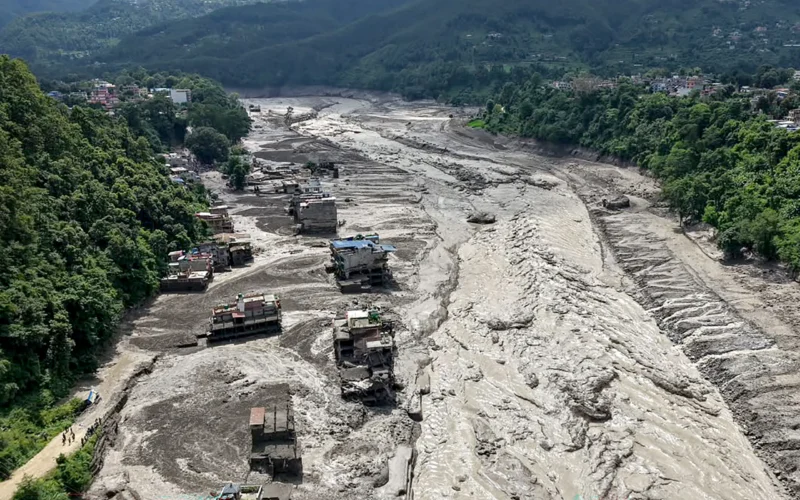
Kathmandu/New Delhi (Rajeev Sharma): A sudden flash flood near Nepal’s border with Tibet has triggered a major rescue operation, with at least 72 people reported dead and 133 Indian nationals among those missing after the disaster swept through parts of the Himalayan country.
The flooding struck Rasuwa district on Wednesday after the Bhote Koshi river suddenly swelled, sending a powerful surge through settlements near the Rasuwagadhi border point. The water destroyed houses, roads, bridges and other infrastructure before moving downstream into the Trishuli river system.
The situation remains fluid, with communications disrupted in several areas and rescue personnel struggling to reach locations cut off by the destruction.
Hundreds Still Unaccounted For
Nepal’s tourism authorities have reported that hundreds of people remain missing following the disaster. Of the missing, a substantial number are tourists and foreign nationals, with Indians forming the largest group among the foreign travellers reported unaccounted for.
At least 37 non-resident Indians are also believed to be among those missing.
The figures could change as authorities establish contact with people stranded in remote areas and search teams gain access to locations affected by the flooding.
Kailash Mansarovar Pilgrims Among Those Affected
The disaster has caused particular concern in India because the affected region is an important route for people travelling towards Tibet for the Kailash Mansarovar Yatra.
Reports indicate that hundreds of pilgrims, predominantly Indians, were preparing to cross into Tibet when the flood struck near Rasuwagadhi.
Spiritual leader Sadhguru Jaggi Vasudev also raised concerns over a pilgrimage group associated with the Isha Foundation that was caught in a flash flood in Tibet’s Gyirong area.
According to information shared by him, 77 members of the group were at an immigration facility when the flooding occurred, but their whereabouts could not immediately be confirmed.
India Mobilises Relief Support
The disaster has prompted India to step up coordination with Nepal and neighbouring authorities.
Prime Minister Narendra Modi spoke with Nepal’s Prime Minister Balendra Shah, expressed condolences over the loss of lives and assured him that India was prepared to extend all possible assistance.
India has sent around 10 tonnes of humanitarian and disaster-relief supplies, including medicines, temporary shelters, blankets, hygiene kits and solar lamps. An Indian Air Force C-130J aircraft was used to transport the material.
Indian diplomatic missions are also working with authorities in Nepal and China to establish the whereabouts of Indian nationals caught in the disaster.
Advisory Issued for Indians in Tibet
The Indian Embassy in Beijing has advised Indian nationals stranded in affected parts of Tibet to seek assistance from local Chinese authorities or contact Indian diplomatic missions in Beijing and Kathmandu.
Officials are maintaining contact with authorities on both sides of the border as efforts continue to trace missing travellers and arrange assistance for those stranded.
Bihar Placed on Alert
The effects of the flooding have also raised concerns downstream in India.
Authorities in Bihar are monitoring river levels closely following warnings about a possible rise in water levels in rivers flowing from Nepal. Several districts along the Gandak have been placed on alert, while disaster-response teams have been deployed and embankments are being monitored.
Tibet Also Hit by Mudslide
The disaster has not been confined to Nepal. China’s Tibet Autonomous Region has also reported severe weather-related damage near Gyirong, where a mudslide struck the border region.
Chinese authorities have launched rescue operations, while President Xi Jinping has called for all possible efforts to locate missing people and limit casualties.
Cause of Flash Flood Under Investigation
The precise cause of the sudden flooding is still being examined. Initial reports have pointed towards an ice-and-rock avalanche or landslide in the Tibet region, which may have caused a sudden surge of water into the river system.
An earthquake was also reported in the region around the time of the incident, although authorities have yet to establish whether it directly contributed to the flooding.
For now, rescue teams in Nepal and Tibet remain focused on reaching isolated communities, locating missing people and providing emergency assistance as the full scale of the cross-border disaster continues to emerge.
