

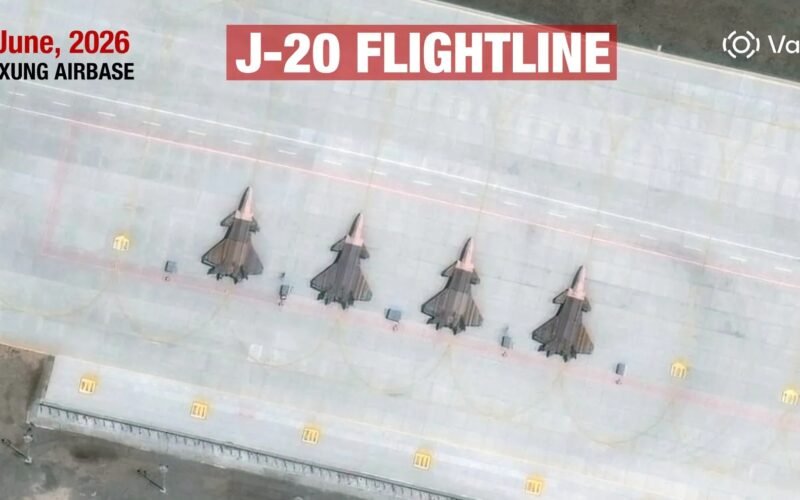
New Delhi (Rajeev Sharma): Fresh satellite imagery has reportedly revealed an increased deployment of China’s advanced J-20 stealth fighter jets at military airbases located close to India’s northern frontier, signalling a continued strengthening of Beijing’s aerial capabilities in the region. According to an NDTV report, at least 11 J-20 aircraft were spotted at two strategically located airbases during late June and early July.
The report, based on satellite images provided by geospatial intelligence firm Vantor, states that seven J-20 stealth fighters were observed at Hotan Air Base in Xinjiang on July 9. The installation is situated relatively close to India’s positions in eastern Ladakh, making it one of the nearest Chinese airbases facing the northern sector.
Another set of images reportedly showed four J-20 aircraft stationed at Damxung Air Base in Tibet, a location overlooking the eastern sector near Arunachal Pradesh.
Defence analysts believe the latest deployment reflects China’s growing confidence in operating fifth-generation combat aircraft from high-altitude bases. Experts quoted in the report suggested that such deployments now appear to be part of routine operational planning rather than temporary military signalling.
Former Indian Air Force fighter pilot and defence expert Sameer Joshi reportedly said that the presence of stealth fighters near the border reinforces the need for India to accelerate the development of counter-stealth detection systems, strengthen its integrated air defence network and enhance long-range strike capabilities.
The J-20, often referred to as the “Mighty Dragon,” is China’s premier stealth fighter and is designed to evade conventional radar systems while undertaking long-range combat missions. Its deployment close to India’s borders is being viewed as an important development in the evolving military balance across the region.
India, meanwhile, is still working towards fielding its first indigenous stealth aircraft through the Advanced Medium Combat Aircraft (AMCA) programme. While the project marks a significant milestone in India’s defence modernisation plans, the aircraft is still under development and is expected to take several years before entering operational service.
The report also highlighted the rapid expansion of China’s stealth fighter fleet. International assessments cited in the report suggest that Beijing has significantly increased J-20 production over the past few years, with annual manufacturing rates rising sharply. Some defence estimates project that China could eventually operate close to 1,000 J-20 fighters by the end of this decade.
Former Vice Chief of the Air Staff Air Marshal Narmdeshwar Tiwari (Retd.) reportedly attributed China’s growing air power to its robust defence manufacturing ecosystem, integrated supply chains and sustained long-term investment in military aviation.
In contrast, the Indian Air Force currently operates 36 Rafale fighter jets, alongside fleets of Su-30MKI, Mirage 2000 and MiG-29 aircraft. India has also placed an order for 26 Rafale-M fighter jets for the Navy, while discussions continue regarding the proposed procurement of 114 additional Rafale aircraft for the Air Force.
The reported deployment of additional J-20 fighters near India’s borders is likely to remain under close observation by defence planners, particularly as both countries continue to modernise their military capabilities and maintain a strong presence along the Line of Actual Control.
