

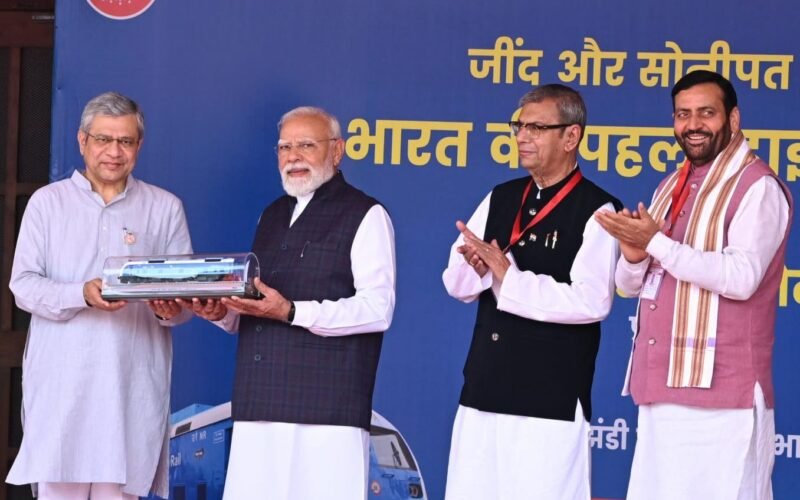
Jind (Balwinder Singh): Prime Minister Narendra Modi highly commended the administrative approach of Haryana Chief Minister Nayab Singh Saini, stating that the province’s “double-engine” administration is actively driven by the philosophy of inclusive development for all sections of society. Addressing a massive public rally in Jind after flagging off the nation’s first hydrogen-powered passenger train, the Prime Minister emphasized that the Saini-led government has consistently delivered robust outcomes for youth, farmers, women, and daughters. He specifically praised the administration’s merit-based, corruption-free employment initiative, noting that delivering government jobs without financial bribes or political recommendations was an incredibly challenging path that the Bharatiya Janata Party government successfully institutionalized.
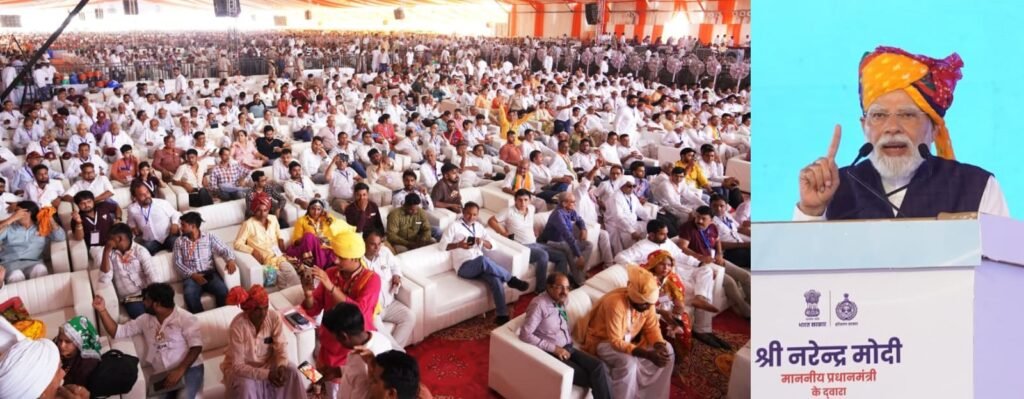
Reflecting on the transformation of the region, the Prime Minister noted that while Jind’s famous dairy products and traditional sweets have remained unchanged over the decades, the overall temperament and infrastructural landscape of the district have completely evolved. Jind, he remarked, has now emerged as a prime example of the BJP-NDA good governance model, with the entire province accelerating on a path of rapid development driven by the dual engines of agriculture and industry. The high-profile event was attended by Haryana Governor Prof. Asim Kumar Ghosh, Chief Minister Nayab Singh Saini, Union Railway Minister Ashwini Vaishnaw, and Haryana Assembly Deputy Speaker Dr. Krishan Middha.
The Prime Minister emphasized that Jind and Haryana have firmly etched their names into transport history with the launch of the indigenous hydrogen fuel-cell train on the Jind-Sonipat route. Drawing historical parallels to India’s first train between Bombay and Thane, he stated that future generations will always associate Haryana with the birth of the nation’s green rail revolution. Describing the technological breakthrough, the Prime Minister explained that while 19th-century rail relied on steam and the 20th century utilized diesel and electricity, the 21st century belongs to hydrogen. He highlighted that India’s new 10-coach, 3200-horsepower hydrogen train is currently the longest and most powerful of its kind globally, representing a monumental achievement for the “Make in India” initiative designed entirely by Indian engineers. This zero-emission infrastructure is expected to catalyze new ancillary factories and generate extensive technical employment for local youth.
Addressing global energy vulnerabilities, the Prime Minister pointed out that the ongoing maritime conflicts in Western Asia and the Gulf region have severely disrupted vital shipping lanes through which India imports petroleum, liquefied petroleum gas, and fertilizers. He asserted that if a similar geopolitical crisis had occurred prior to 2014, when the vast majority of the rail network was entirely dependent on diesel, the entire Indian Railways network would have ground to a halt. He credited strategic foresight and timely energy diversification for shielding the national logistics network from external supply shocks.
The Prime Minister also detailed the extensive highway network reshaping the region, noting that with the dedication of the Haryana section of the Delhi-Amritsar-Katra Expressway and the Jind-Gohana National Highway, alongside the Ambala-Kala Amb four-lane corridor, Jind has achieved the rare distinction of being connected by five distinct national highways. This unparalleled connectivity is set to drastically lower transportation costs for farmers and livestock breeders seeking access to major commercial markets. On agricultural welfare, he noted that the central government has disbursed nearly ₹8,000 crore to state farmers under the PM Kisan Samman Nidhi, with over ₹600 crore directly benefiting cultivators in Jind alone. Furthermore, the Prime Minister fulfilled housing aspirations by symbolically distributing keys to five beneficiaries of the PM Awas Yojana (Gramin).
Turning to sports and international diplomacy, the Prime Minister shared updates from his recent bilateral visits to Australia and New Zealand, revealing that comprehensive agreements were structured around sports industries and elite athlete training. With India preparing to host the 2030 Commonwealth Games and actively bidding for the 2036 Olympic Games, he urged the youth of Haryana to utilize the enhanced facilities provided under the Khelo India and Target Olympic Podium Scheme to prepare for global competitions. Culturally, the Prime Minister highlighted the foundation stone laying of a state-of-the-art Sikh Museum in Kurukshetra, affirming that the institution will leverage modern interactive technology to preserve the valor and spiritual teachings of the Sikh Gurus for successive generations.
