

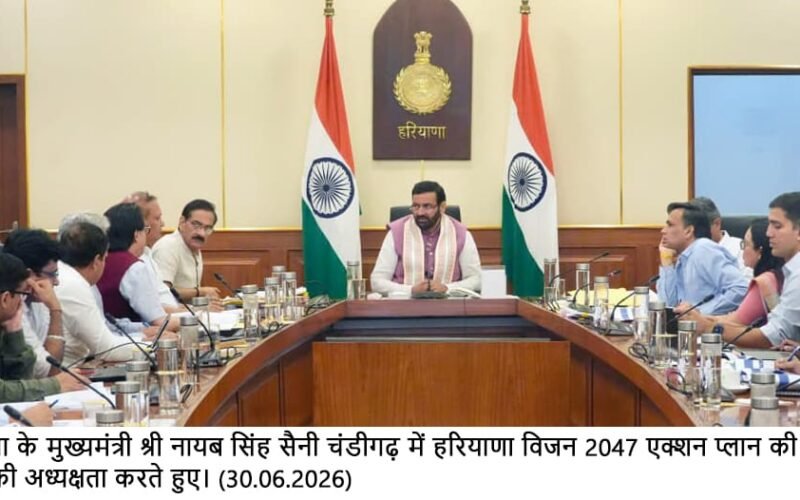
Chandigarh (Balwinder Singh): The Haryana Government has finalized a comprehensive five-year roadmap to transform its urban landscape into highly advanced, self-sustaining, and future-ready hubs. Presiding over a high-level review meeting of the Urban Local Bodies Department under the Haryana Vision-2047 initiative at the Haryana Civil Secretariat on Tuesday, Chief Minister Nayab Singh Saini issued wide-ranging directives to elevate municipal infrastructure. The Chief Minister reviewed the ongoing progress of budgetary announcements and the state’s welfare commitments, instructing top bureaucrats to implement citizen-centric amenities within a strict timeframe.
As part of the modernization drive, the state government is developing an ‘Integrated Super App’ directly linked with property identification data. The multifunctional mobile application will allow urban residents to seamlessly pay property taxes and water utilities while registering and tracking municipal grievances, completely eliminating the need to physically visit local government offices. To improve ease of living, the Chief Minister directed the immediate installation of multilingual touchscreen information kiosks across public squares and the rollout of free high-speed Wi-Fi infrastructure in municipal markets, starting with pilot projects in Gurugram and Faridabad to guarantee 24-hour drinking water availability.
Addressing critical ecological and seasonal challenges, Saini mandated the strict installation of rainwater harvesting systems in all state-owned buildings and private houses exceeding 250 square yards to restore depleting groundwater tables, particularly targeting waterlogging-prone districts during the active monsoon. Commissioner and Secretary of the Urban Local Bodies Department Ashok Kumar Meena reported that 120 harvesting units have been set up in Gurugram, with 300 additional units underway across 50 municipal bodies. Furthermore, the Chief Minister ordered the planting of one lakh saplings under the ‘Ek Ped Maa Ke Naam’ campaign during the monsoon—including 20,000 trees in Gurugram alone—supported by dedicated maintenance staff and protective tree guards.
The development plan also places heavy emphasis on structural waste management and mega township initiatives. Saini ordered the accelerated execution of strategic Waste-to-Energy plants in Gurugram, Faridabad, Hisar, Yamunanagar, and Ambala to process urban garbage into electricity and organic fertilizers, alongside reviewing critical drainage works in Rohtak, Bahadurgarh, and Jhajjar. In a bid to adopt global best practices, Panchkula, Gurugram, Faridabad, and Sonipat will be paired with international municipalities under the ‘Sister City’ framework to create theme-based modern districts. Additionally, the government has cleared the blueprint to develop a massive 5,000-acre greenfield ‘Namo City’ along the Kundli-Manesar-Palwal Expressway corridor, alongside a specialized ‘Wedding City’ in Pinjore. The administration has allocated ₹838 crore to develop basic infrastructure like paved streets, water connections, and electricity grids in newly regularized colonies, with strict enforcement protocols put in place to permanently curb the growth of any illegal unauthorized habitations.
