

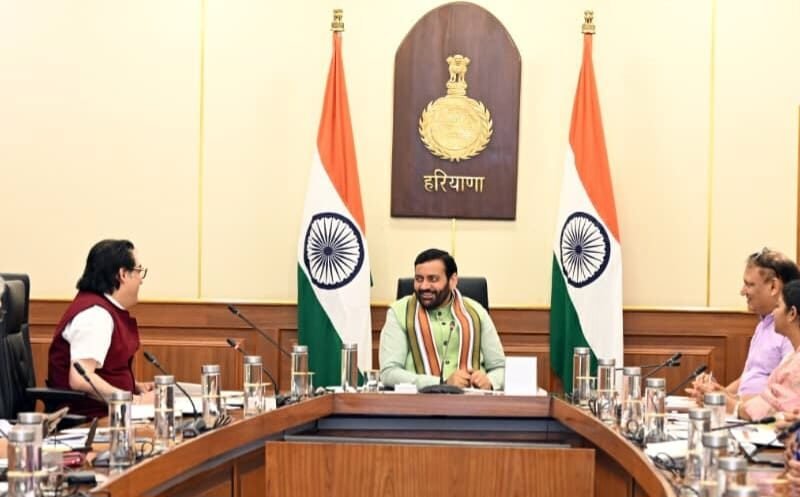
Chandigarh (Balwinder Singh): Haryana Chief Minister Nayab Singh Saini has announced the formation of specialized Joint Task Forces in both rural and urban areas of the state to aggressively curb the sale of narcotics and crack down on those involved in the illicit drug trade. Reviewing the five-year roadmap and action plan of the Social Justice, Empowerment, Scheduled Castes & Backward Classes Welfare and Antyodaya (SEWA) Department under the ‘Haryana Vision-2047’ initiative at the Haryana Civil Secretariat, the Chief Minister directed officials to make these task forces highly empowered and formidable. He stated that the operational network must strike fear into the minds of drug peddlers, forcing them to abandon their illegal activities entirely. To reinforce this state-wide crusade, the Chief Minister administered a formal pledge to all attendees, urging collective cooperation to make families, society, and the nation completely drug-free.
To systematically dismantle the local distribution networks, Chief Minister Saini instructed that the rural task forces will operate under the leadership of the SEWA department and comprise village Sarpanches, ward members, Block Development and Panchayat Officers (BDPOs), Station House Officers (SHOs), and active local NGOs. Similarly, the urban units will feature municipal secretaries, ward councillors, SHOs, and NGOs to identify hotspots and execute strict punitive actions against smugglers. Alongside law enforcement, the Chief Minister prioritized the rehabilitation of victims, announcing that additional de-addiction and rehabilitation centers will be opened across Haryana, including a new six-acre public-private partnership facility in Kurukshetra. He mandated a three-month post-treatment supervision window for recovering individuals, coupled with specialized skill development training to effectively reintegrate them into the mainstream workforce.
During the exhaustive administrative review, the Chief Minister issued directives to ease the lives of senior citizens and support vulnerable groups across the state. He ordered the establishment of a Senior Citizen Club in every district, equipped with recreational lounges, psychologists, and physiotherapists, alongside an initial phase to train 1,000 professional caregivers through Shri Vishwakarma Skill University and other private institutions. For children with disabilities, he called for a comprehensive registration policy to streamline financial grants to high-performing welfare institutions. Furthermore, the Chief Minister lauded the department’s recent achievement of adding 63,000 new beneficiaries to old-age and welfare pension schemes over the past three months, directing the implementation of smooth online verification modules to resolve data discrepancies.
Concluding the meeting, Chief Minister Saini evaluated the ongoing educational and women’s welfare schemes, emphasizing digital efficiency. He noted that moving the verification process online has drastically accelerated scholarship distribution for Scheduled Caste, Backward Class, and Economically Weaker Section (EWS) students, and ordered the priority clearance of past backlogs alongside the setup of dedicated student hostels in all district headquarters. Reviewing the flagship Lado Lakshmi Yojana, the Chief Minister assured that the program remains fully funded, with its budget scaled up from ₹5,000 crore to ₹6,500 crore, ensuring that additional financial assistance does not disrupt existing pensions for enrolled women. Finally, he reviewed health infrastructure upgrades, including expanding the de-addiction bed capacity at Dabwali from 10 to 30, establishing a 20-bed center at Ellenabad, and setting up a separate 100-bed de-addiction wing at the Sant Sarsai Nath Medical College in Sirsa.
