

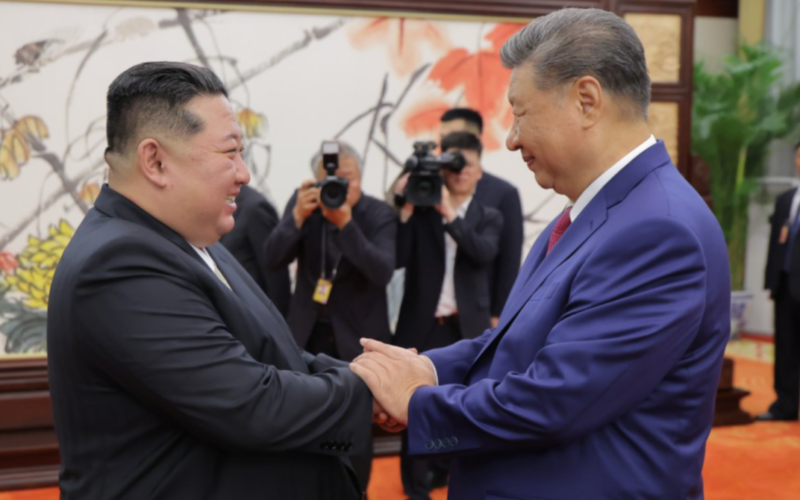
Beijing (Rajeev Sharma): Chinese President Xi Jinping is scheduled to arrive in North Korea on Monday for a critical two-day state visit, marking his first trip to the isolated nation in nearly seven years. The diplomatic mission provides North Korean leader Kim Jong Un with a prominent international stage to display an increasingly assertive foreign policy, heavily anchored by a strategic realignment with his country’s traditional Cold War benefactors.
As North Korea’s primary economic lifeline, Beijing is widely expected to utilize the summit to re-establish its traditional influence over Pyongyang. This strategic pivot comes at a time when the North Korean regime has noticeably gravitated toward Moscow, providing material and manpower support to back Russia’s ongoing military campaign in Ukraine. The upcoming talks will be the first face-to-face meeting between Xi and Kim since September 2025, when Kim traveled to Beijing to attend a major military parade commemorating the conclusion of the Second World War.
From the perspective of Pyongyang, the high-level engagement reflects a calculated effort to erode international isolation by fostering a united front against Washington, aligned with the narrative of an emerging “new Cold War.” Historically, North Korea has maintained a policy of balanced diplomacy between Beijing and Moscow to maximize political and economic concessions. While Kim continues to receive critical military technology and strategic assistance from Russia, experts note that domestic promises to elevate the living standards of the North Korean populace remain entirely dependent on robust economic cooperation and aid from China. Consequently, the bilateral talks are anticipated to touch upon the resumption of Chinese tourism, infrastructure expansion along border rivers, and collaborative development projects involving China, Russia, and North Korea.
Furthermore, the summit is viewed as a foundational move for North Korea to strengthen its leverage ahead of any potential future re-engagement with Washington. Pyongyang has so far resisted diplomatic overtures from US President Donald Trump during his second term, stipulating that the United States must first dismantle its hostile policies and formally accept North Korea’s status as a nuclear-armed power before formal negotiations can resume.
For Beijing, the visit represents an opportunity to restore equilibrium in its backyard by pulling a traditional treaty ally back toward its direct sphere of influence. Xi, who has become exceptionally selective regarding international travel since the pandemic, chose Pyongyang for his first overseas destination of the year, following closely on the heels of hosting both Trump and Putin in Beijing. Analysts suggest this timing is intended to signal that no major modifications to the security architecture of the Korean Peninsula can occur without China’s direct participation. Additionally, observers will closely monitor whether official Chinese statements omit reference to the “denuclearisation” of the peninsula—a traditional diplomatic benchmark—which would signal a tacit acceptance of North Korea’s nuclear capabilities in exchange for regional stability and strategic economic access to border estuaries.
