

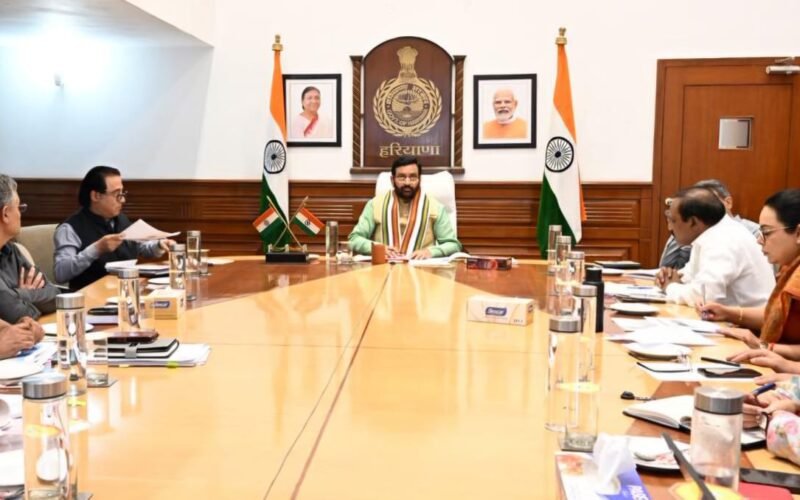
Chandigarh (Balwinder Singh): Haryana Chief Minister Nayab Singh Saini announced that reducing the reliance on private vehicles is vital for lowering petroleum and diesel consumption, a goal that can only be achieved by expanding the reach of public transit. Presiding over a review meeting for the Transport Department’s five-year roadmap under the Haryana Vision-2047 initiative, the Chief Minister instructed officials to design a comprehensive statewide route map aligned with population growth and future transit demands, ensuring that an increased number of villages and cities are effectively linked through an updated transit system.
During the meeting at the Haryana Civil Secretariat, the Chief Minister analyzed new technologies and operational frameworks aimed at optimizing current fleet management to eliminate bus shortages and guarantee broad public access. He observed that while population figures have surged across Haryana’s 6,500 villages and urban sectors, the expansion of the public bus network has historically lagged behind. To counter this, the department will create integrated village clusters connected by dedicated transit loops, modifying older policies where necessary, with the definitive goal of eliminating completely unconnected villages within the calendar year to benefit students, women, and daily commuters.
Urban centers will see a major revival of internal local bus services to accommodate outward industrial and residential expansion. Chief Minister Saini directed that city buses must routinely connect major hospitals, educational institutions, and religious landmarks, alongside specialized routes for industrial hubs like Gurugram, Faridabad, and Sonipat. Additionally, mini-bus shuttle services will be introduced to link major metro stations and central bus terminals, bridging the gap for industrial workers who currently depend on personal vehicles.
To modernize the commuter experience, Haryana will implement a railway-style real-time tracking system across its entire fleet, allowing passengers to monitor precise vehicle locations and arrival times via a dedicated mobile app. Security upgrades will include central control room-linked CCTV installations and panic buttons to prioritize passenger safety. On the environmental front, the state plans to focus exclusively on electric bus procurement, backing the transition with ten new electric bus terminals equipped with high-speed charging infrastructure designed to power vehicles during standard passenger boarding intervals. Rooftop solar arrays and public-private partnership charging stations will also be distributed across the state to boost clean energy production.
Substantial progress was also reported on the social welfare and regulatory fronts, with the Chief Minister reviewing the HAPPY card scheme, which has already provided free transit benefits to 20 lakh beneficiaries and is slated to distribute an additional 20 lakh cards shortly. Furthermore, manual vehicle fitness testing will be entirely phased out in favor of automated systems compliant with Union Government mandates to reduce wait times. Haryana currently leads the nation with 26 functional vehicle scrapping centers, a network that the state plans to expand along its borders to attract interstate commercial traffic and secure maximum central government incentives.
Strict environmental regulations will also be enforced using automated number plate recognition cameras installed at petrol pumps to identify vehicles operating without valid Pollution Under Control certificates, effectively blocking fuel sales to non-compliant violators by September 30 in National Capital Region districts. All public and private transport monitoring will eventually be consolidated under a state-level Unified Command Control Center being established this year, alongside the modernization of existing bus stands to include advanced sewage and effluent treatment plants.
