

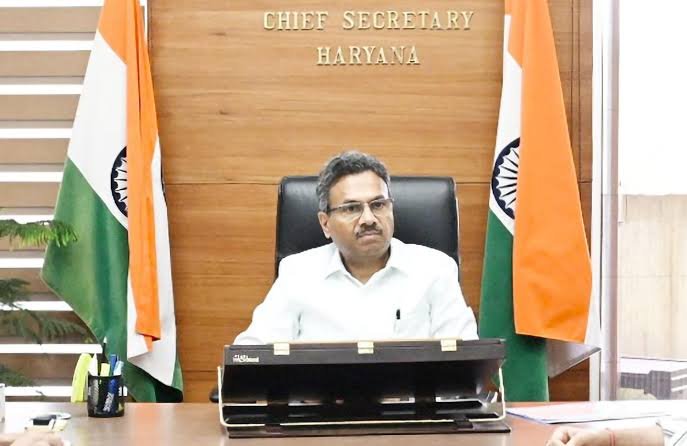
Chandigarh (Balwinder Singh)- Haryana is steadily advancing towards scientific and sustainable waste management, with Chief Secretary Sh. Anurag Rastogi on Thursday reviewing the state’s progress on compliance with directions of the National Green Tribunal (NGT). The review reflected a positive trajectory, with major improvements in infrastructure, monitoring mechanisms, and environmental governance.
Chairing the high-level meeting, the Chief Secretary stressed the importance of continuous monitoring, accurate reporting, and coordinated action across departments to ensure timely compliance with NGT directives. He reiterated that Haryana is committed to achieving full compliance through a structured and result-oriented approach.
Significant progress has been made on the ground. Scientific waste processing through composting is now operational in 53 Urban Local Bodies, with the output being effectively utilised in agriculture and horticulture. One Waste-to-energy plant is functional at Sonepat, while work is progressing rapidly to expand processing facilities across remaining areas.
Legacy waste remediation has also gathered pace, with work completed at a majority of identified sites. The remaining waste is being targeted for scientific disposal within defined timelines, indicating a clear shift towards long-term environmental sustainability.
At the operational level, Haryana has achieved near-universal door-to-door waste collection, covering about 98 percent of wards, while source segregation has also improved significantly. The state is now focusing on bridging the remaining gap in waste processing capacity, with a target to achieve full coverage by the end of 2026.
To ensure better coordination and monitoring, district-level task forces have been constituted under Deputy Commissioners, bringing together multiple departments for integrated action. Nodal officers have also been deployed at the urban local body level to strengthen supervision and accountability.
The Chief Secretary also reviewed earlier observations made by the Tribunal and directed departments to further improve data accuracy, strengthen reporting systems, and expedite ongoing projects related to both solid and liquid waste management.
Commissioner and Secretary, Urban Local Bodies, Sh. Ashok Kumar Meena informed that with sustained efforts, strong institutional mechanisms, and technology-driven monitoring, Haryana is fast emerging as a model state in environmental management.
Additional Chief Secretary, Environment, Forests & Wildlife Department, Sh. Sudhir Rajpal, Member Secretary, Haryana State Pollution Control Board, Sh. Yogesh Kumar, Joint Director (Admin), Urban Local Bodies, Sh. Kanwar Singh and other senior officers were present in the meeting.
