

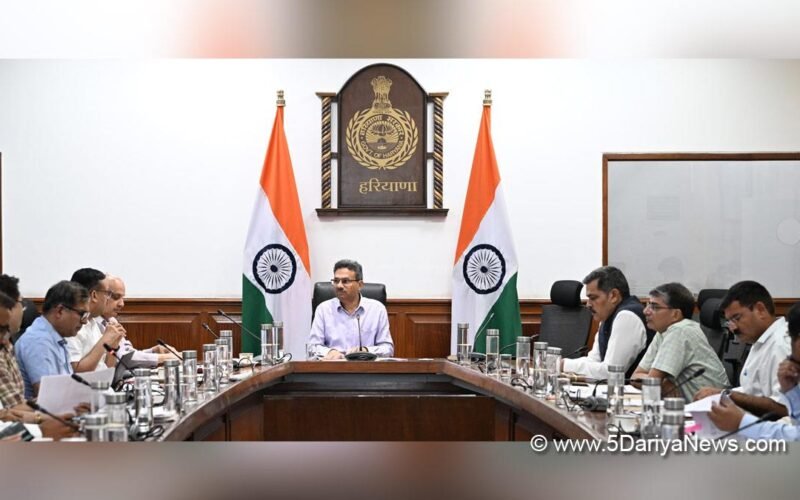
Chandigarh (Balwinder Singh): Haryana Chief Secretary Sh. Anurag Rastogi chaired a detailed review meeting with Deputy Commissioners, Registrars of universities and senior officers to accelerate the implementation of the Gyan Bharatam initiative and the National Manuscript Survey across the state.
The Chief Secretary said the programme reflects the vision of Prime Minister Sh. Narendra Modi, who has emphasised preservation, innovation and adaptation as key pillars of India’s knowledge tradition. The Gyan Bharatam portal, launched in September 2025, aims to identify and preserve centuries-old manuscripts using modern technology.
Sh. Rastogi directed Deputy Commissioners to ensure a systematic and time-bound survey in every district, covering manuscripts available in institutions as well as with private custodians such as temples, universities, libraries and individual collectors. He stressed that proper documentation, cataloguing and creation of standardised digital records would be essential for building a comprehensive national database.
Reviewing the execution strategy, the Chief Secretary said the survey would follow a structured process beginning with the identification of manuscripts and custodians, followed by physical verification and condition assessment, detailed cataloguing and metadata recording, conservation and high-quality digitisation, and finally validation at the repository level to ensure authenticity and accuracy.
Emphasising the role of technology, he highlighted the deployment of high-end scanners, creation of metadata, and the uploading of digitised manuscripts to a secure national digital repository with cloud storage. He also pointed to the use of advanced tools such as Optical Character Recognition and Handwritten Text Recognition, being developed in collaboration with technology partners, to make ancient texts more accessible.
The Chief Secretary further underlined the importance of capacity building, noting that conservation training programmes are being organised across zones, along with specialised training in ancient scripts such as Old Devanagari and Modi script to create skilled manpower for preservation work.
Sh. Rastogi also stressed adherence to a clear administrative framework, with state-level monitoring under the Chief Secretary and district-level committees headed by Deputy Commissioners. He directed that regular and fortnightly review meetings be conducted to closely monitor progress and resolve bottlenecks.
Officials were instructed to strictly follow the timeline, with the field survey to be completed within three months from March to June 2026, supported by pre-survey coordination and continuous monitoring.
Highlighting the importance of public engagement, he directed departments to intensify outreach through universities, cultural and religious institutions, advertisements in media platforms and expert networks. He also reviewed initiatives such as the Abhilekh Daan Abhiyan to encourage voluntary contribution of archival materials and the Dharoharshastri Internship Programme aimed at involving students in archival work. He also appealed to citizens to download the Gyan Bharatam app and voluntarily provide information related to manuscripts.
The Chief Secretary said the initiative will lead to the creation of a comprehensive manuscript database, identification of rare and endangered manuscripts, development of a GIS-based national repository, and strengthening of institutional and community participation in preserving India’s rich knowledge heritage.
ACS, Higher Education, Sh. AK Singh joined the meeting via videoconferencing while Commissioner & Secretary, Archives Department, Sh. Shekhar Vidyarthi, Director, Archives, Dr. Balpreet Singh, Deputy Director, Archives Department, Manju Yadav, and other senior officers were present in the meeting.
