

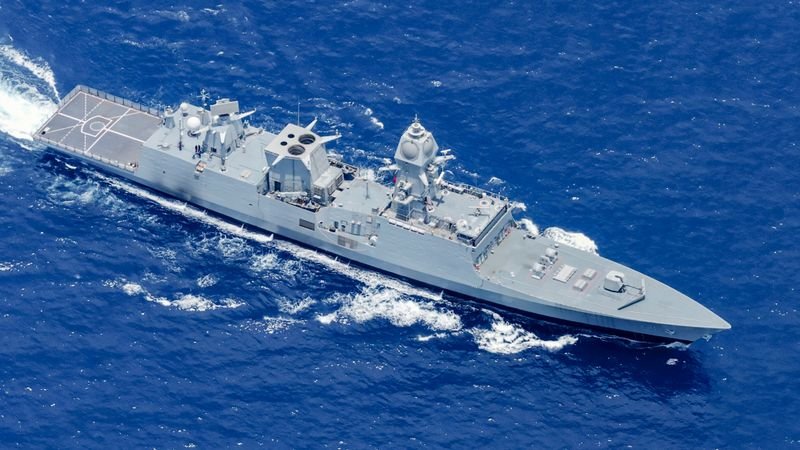
New Delhi (Gurpreet Singh): The Indian Navy is set to significantly bolster its maritime strike capabilities with the commissioning of the indigenous stealth frigate ‘Taragiri’ on April 3, 2026. Officials confirmed on Saturday that the ceremony will take place in Visakhapatnam and is scheduled to be presided over by Defence Minister Rajnath Singh. As the fourth potent platform of the Nilgiri-class (Project 17A), the vessel is being hailed as a “quantum leap” in naval design and a definitive symbol of India’s journey toward becoming a self-reliant naval power under the ‘Aatmanirbharta’ initiative.
Built by Mazagon Dock Shipbuilders Limited (MDL) in Mumbai, ‘Taragiri’ (Yard 12653) is a 6,670-tonne warship that was formally delivered to the Navy on November 28 last year. The frigate features a sophisticated stealth design with a significantly reduced radar cross-section, allowing it to operate with lethal invisibility in contested waters. Driven by a Combined Diesel or Gas (CODOG) propulsion plant, the ship is engineered for high speed, high endurance, and multi-dimensional maritime operations, ranging from high-intensity combat to humanitarian assistance and disaster relief (HADR).
The frigate’s weapon suite is world-class, integrating supersonic surface-to-surface missiles, medium-range surface-to-air missiles, and a specialized anti-submarine warfare suite. These systems are managed through a state-of-the-art indigenous Combat Management System, ensuring split-second precision against modern threats. With over 75% indigenous content, the construction of ‘Taragiri’ has supported a domestic industrial ecosystem involving more than 200 MSMEs, contributing significantly to local job creation and the ‘Make in India’ spirit.
A Navy spokesperson described ‘Taragiri’ as a “premier hunter of the seas” and an ironclad guardian of India’s blue frontiers. Its commissioning marks a defining moment for the nation’s maritime sovereignty, reinforcing the Navy’s status as a combat-ready, cohesive, and credible force. The vessel stands as a testament to the sophisticated engineering capabilities of Indian shipyards, reflecting a generational leap over earlier frigate designs in terms of firepower, automation, and survivability.
