

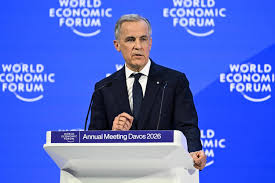
Quebec City (Rajeev Sharma): Prime Minister Mark Carney is meeting with his cabinet in Quebec City for closed-door discussions aimed at setting the federal government’s priorities for the year ahead, following a high-profile international appearance that underscored a tougher tone toward the United States and a broader reassessment of Canada’s global role.
The two-day meeting, beginning Thursday at the Citadelle of Quebec, comes after Carney concluded a multi-country trip to China, Qatar and Switzerland. During his appearance at the World Economic Forum in Davos earlier this week, the prime minister warned that the existing global order is fading and urged so-called middle powers to push back against economic pressure tactics such as tariffs — remarks widely interpreted as a rebuke of U.S. President Donald Trump.
The Quebec City gathering, described by officials as a planning forum ahead of Parliament’s return next week, is being held at the historic fortress that serves as the Governor General’s secondary residence. Political observers say the choice of venue and timing reflect the gravity of the moment.
Former senior government strategist Marci Surkes said the meeting is unlike a routine cabinet retreat, arguing ministers are being asked to adapt to what she described as an increasingly confrontational international environment. She said the prime minister is signalling that the government must operate under a fundamentally different mindset, given the rapid shifts in global alliances and economic pressures.
Since Parliament rose for the winter recess, the international landscape has evolved sharply. The United States has taken dramatic steps in Latin America, escalated rhetoric over Greenland and continued to threaten tariffs on key global partners, before partially easing some of those positions following discussions with NATO leadership.
In Davos, Carney framed the moment as an opportunity for renewal rather than decline, arguing that the collapse of the old order could make room for a more balanced and fair global system. That message, analysts say, is expected to shape the tone of the cabinet discussions, which will focus on economic stability, affordability, national security and Canada’s trade relationships.
Trade with the United States is expected to loom large over the talks, as ongoing tariffs on sectors such as steel, aluminum, autos and lumber continue to weigh on Canadian industries. A scheduled review of the Canada–U.S.–Mexico Agreement later this year adds further uncertainty.
Carney will also brief ministers on a contentious trade arrangement reached with China, which would allow a limited annual quota of Chinese electric vehicles into Canada in exchange for reduced Chinese tariffs on Canadian agricultural and seafood exports. The deal has drawn criticism from Ontario Premier Doug Ford, who argues it could harm the province’s auto sector and has urged consumers to boycott Chinese-made electric vehicles.
Meanwhile, Carney is preparing for a meeting with provincial premiers next week, where tensions over trade, industry protection and foreign policy are expected to surface.
Domestically, Parliament resumes Monday under slightly altered circumstances. The Liberals have edged closer to a majority following a recent floor crossing by a Conservative MP, while the departure of longtime Liberal Chrystia Freeland has triggered the need for at least one byelection. Carney has hinted that additional byelections may follow, suggesting further changes ahead in the House of Commons.
Despite the heavy focus on foreign affairs, political analysts caution that domestic cost-of-living pressures remain a critical challenge for the government. Rising food prices and lingering inflation continue to resonate with voters, an area where critics argue the Liberals must sharpen their response as the Conservatives seek to capitalize on economic anxiety.
