

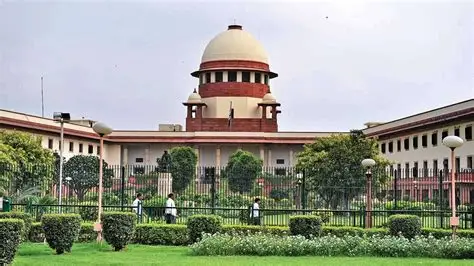
New Delhi (Gurpreet Singh): The Supreme Court of India asserted on Thursday that the integrity of the democratic process depends entirely on an Election Commission that is not only independent in its actions but also appears independent in its composition. While presiding over a series of public interest litigations challenging the 2023 law governing the appointment of the Chief Election Commissioner and Election Commissioners, a Bench comprising Justice Dipankar Datta and Justice SC Sharma highlighted that the independence of the body is a fundamental facet of the basic structure of the Constitution. The hearing brought to the forefront a significant debate regarding the balance of power between the judiciary and the legislature concerning the selection of officials responsible for overseeing the nation’s elections.
The legal challenge focuses on the Chief Election Commissioner and other Election Commissioners (Appointment, Condition of Service and Term of Office) Act, 2023, which replaced the Chief Justice of India with a Union Cabinet Minister in the three-member selection panel led by the Prime Minister. During the proceedings, the Bench expressed concern over the degree of public confidence in the current selection mechanism, questioning why a neutral third party was not maintained to ensure the appearance of impartiality. Justice Datta noted that the level of confidence must be high enough that the commission’s neutrality is never in doubt, prompting a spirited defence from the Centre.
Attorney General R. Venkataramani defended the legislation, arguing that Parliament has the absolute right to legislate and was not bound to adhere to the “stop-gap” arrangement previously suggested by a five-judge Constitution Bench. He cautioned the court against overstepping into the legislative arena, suggesting that a law should not be struck down based on hypothetical bias. The Attorney General maintained that the validity of the law should be judged based on the actual functioning of the commissioners rather than abstract concerns. He emphasized that the judiciary must respect the constitutional boundaries between the various organs of the state, a sentiment the Bench acknowledged while maintaining its duty to uphold constitutional standards.
The petitioners, including former bureaucrats and the NGO Lok Prahari, argued that the 2023 Act undermines the safeguards established in the earlier Anoop Baranwal judgment. That landmark ruling had temporarily placed the Chief Justice of India on the selection panel to ensure a non-partisan approach until a formal law was enacted. Critics of the current law contend that by replacing the judicial member with a Cabinet Minister, the selection process becomes heavily tilted toward the executive branch. As the Supreme Court continues to examine these constitutional questions, the outcome will likely have long-standing implications for the institutional autonomy of the body tasked with managing the world’s largest democratic exercises.
