

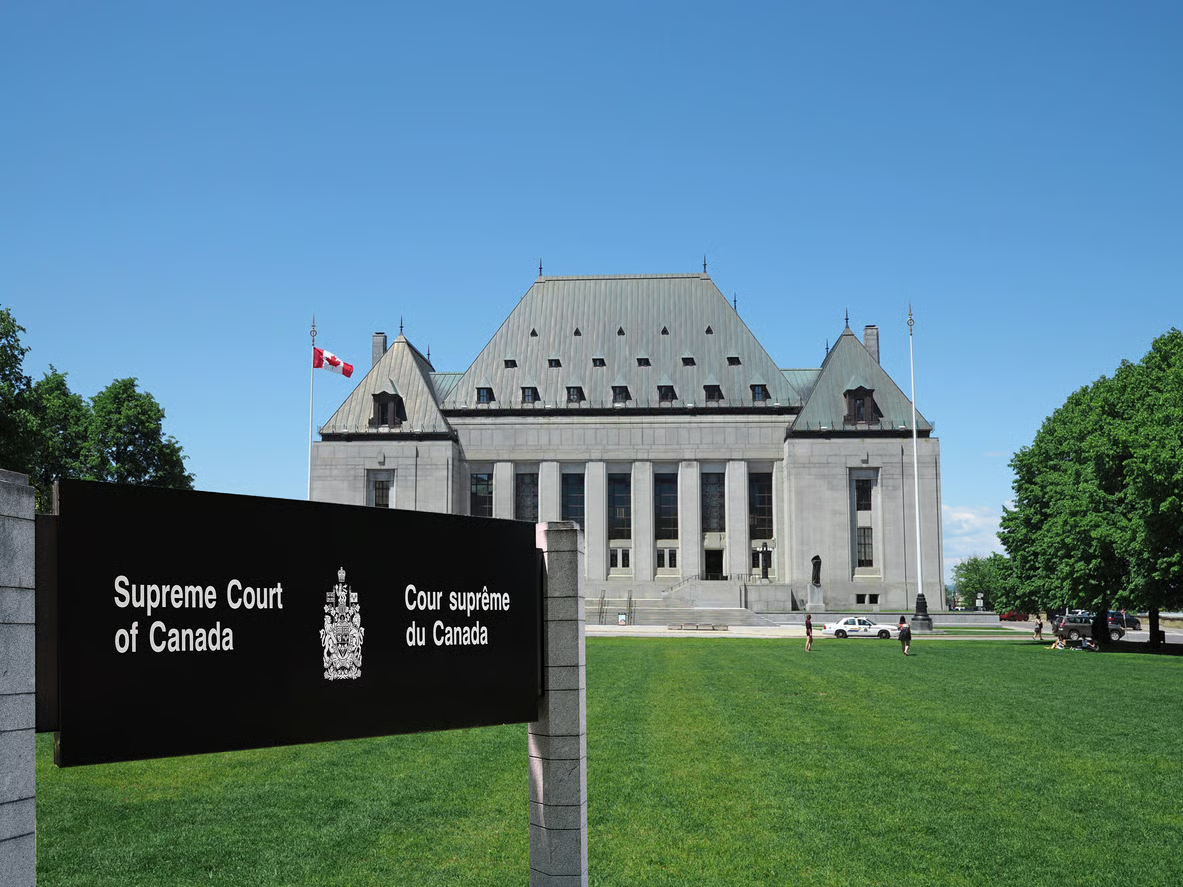
Ottawa, January 19, 2026: The Supreme Court of Canada on Monday began hearing arguments in a landmark Quebec case that could have far-reaching implications for policing practices across the country, particularly the legality of random police traffic stops.
The case centres on a challenge by the Quebec government to a lower court ruling that struck down provisions allowing police to conduct traffic stops without cause, finding that such powers contributed to racial profiling and violated constitutional rights.
The matter originated from a legal challenge filed by Joseph-Christopher Luamba, a Montreal resident, who alleged that he was repeatedly stopped by police without justification after obtaining his driver’s licence. Over an 18-month period, Luamba said he was pulled over nearly a dozen times, none of which resulted in any traffic violation or fine. Luamba, who is Black, told the court he believed the stops were racially motivated and caused ongoing psychological stress.
In October 2022, the Quebec Superior Court ruled that Article 636 of Quebec’s Highway Safety Code, which permits random traffic stops, violated Sections 7 and 9 of the Canadian Charter of Rights and Freedoms. The court held that the provision infringed the rights to liberty, security of the person, and freedom from arbitrary detention. The ruling was later unanimously upheld by the Quebec Court of Appeal.
Quebec’s attorney general has now appealed to the Supreme Court, arguing that the lower courts erred in overturning long-standing legal precedent. The province relies on the Supreme Court’s 1990 judgment in R. v. Ladouceur, which upheld random traffic stops as a justified and proportional policing tool for checking licences, vehicle safety and driver sobriety.
In its submissions, Quebec has acknowledged that racial profiling is a serious issue, but maintains that random stops are not conducted based on a driver’s race and remain essential for public safety. The Canadian Association of Chiefs of Police and several Quebec police leaders have supported the appeal, arguing that random stops are a critical enforcement mechanism.
Advocacy group Mothers Against Drunk Driving (MADD) has also intervened, contending that random stops play an important role in detecting and deterring impaired driving, particularly in rural areas where organized roadblocks are less effective.
Luamba’s legal team, however, argues that increased awareness and evidence of racial profiling over the past three decades warrant a reassessment of the 1990 precedent. The Quebec Superior Court had observed that arbitrary police powers had, in practice, become a conduit for racial profiling, particularly affecting Black motorists.
Random police traffic stops have remained suspended in Quebec since April 2025, after the Court of Appeal refused to allow their continuation pending the Supreme Court’s ruling.
The Supreme Court is expected to hear arguments over two days and may take several weeks or months to deliver its verdict. A decision against Quebec could prompt a nationwide reassessment of random traffic stop powers, which are currently permitted in all other provinces under existing Supreme Court jurisprudence.
